




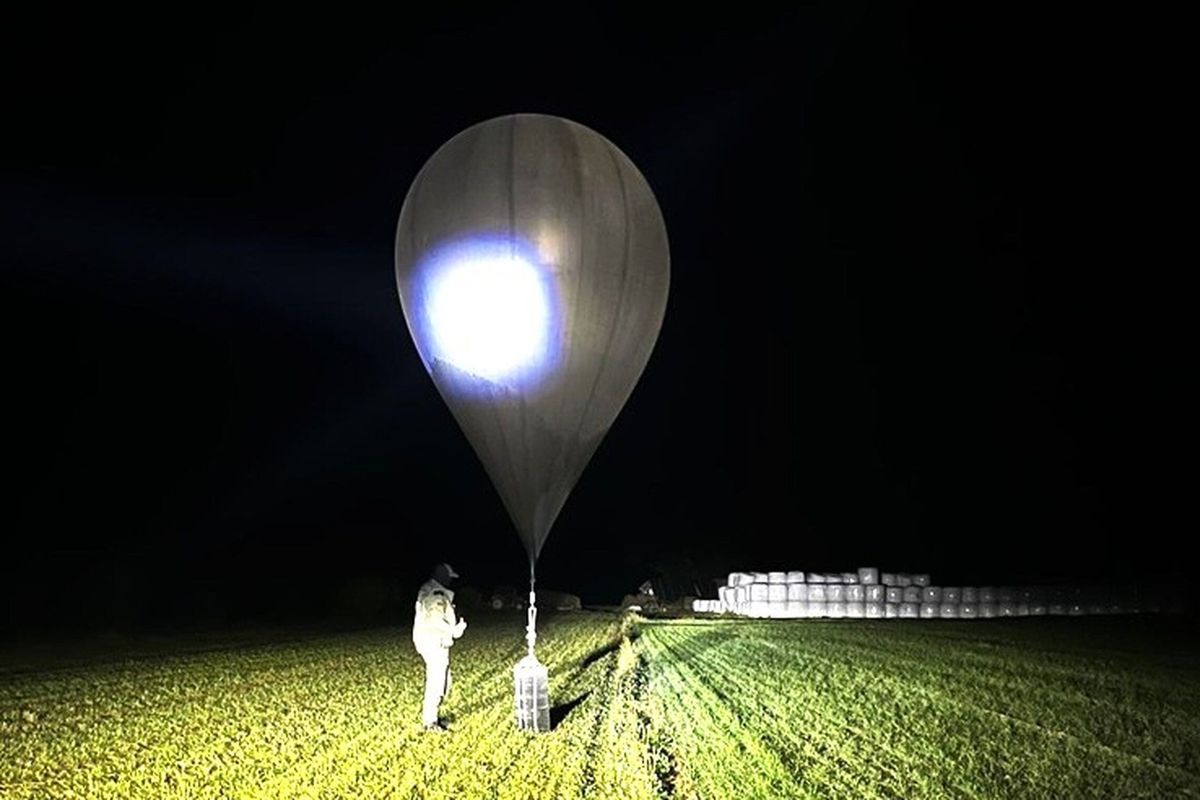

VILNIUS, Lithuania (AP) — Tensions between Lithuania and Belarus have escalated after meteorological balloons from Belarus forced Lithuania to repeatedly shut down its main airport in the past weeks, leaving thousands of people stranded.
While the balloons are used to smuggle cigarettes into Lithuania, officials in Vilnius see their numbers and trajectories as deliberate acts of disruption orchestrated by Belarus, a close Russian ally, as Europe remains on high alert after drone intrusions into NATO’s airspace reached an unprecedented scale in September and the Russian invasion of Ukraine nears its fourth year.
‘A cynical hybrid attack’
In the most recent incident, operations at Vilnius airport were suspended for 11 hours on Saturday night. Lithuanian authorities said at least 60 balloons were flown from the woods in Belarus, 40 of them reaching areas critical for aviation safety and making it one of the most serious incidents to date. Lithuanian aviation authorities said the balloons appeared to be sent at regular time intervals and directed at the runways.
“This is a cynical hybrid attack against our economy, aviation security, and the entire nation,” Taurimas Valys, Lithuania’s deputy minister of foreign affairs, said about the incident.
Belarusian President Alexander Lukashenko had previously said that Belarus would apologize if its involvement was established.
On Monday, Minsk pointed a finger at Lithuania for allegedly sending a drone into the country’s airspace, claiming it was to be used for espionage and the delivery of “extremist materials.”
The Belarusian Foreign Ministry on Monday summoned Lithuania’s chargé d’affaires, Erikas Vilkanecas, and demanded an explanation and a probe into the incident.
“The Republic of Belarus reserves the right to take all necessary measures to protect its sovereignty and security, based on the current situation,” the ministry said in a statement Monday.
Lithuanian Prime Minister Inga Ruginienė said Tuesday she had received no information suggesting that Lithuania was involved in the incident, according to the BNS news agency.
High tesnions
In October, Lithuania closed its borders with Belarus after balloons repeatedly disrupted activity at the Vilnius airport.
In retaliation, Minsk prevented over 1,000 Lithuanian cargo trucks from exiting Belarus. Those trucks remain in Belarus, although the Lithuanian government gave in to pressure from the national logistics companies and reopened the border less than three weeks after it was shuttered.
Since then, Lithuanian authorities have noted that the number of balloons flying in has continued to rise.
“If necessary, we will close the border, but please understand that we must coordinate every action with our strategic partners,” Ruginienė said on Tuesday.
An attempt at a solution
Lithuanian authorities offered 1 million euros to projects that could help defend against the disruption.
IT Logika, one of the beneficiaries, plans to develop an Intelligent Airspace Security System (IOEAS) to detect and identify targets at any time of the day, as well as a high-power laser to safely shoot down multiple balloons during the same flight. Object trajectory prediction and recognition would be performed using artificial intelligence algorithms. Real-time information would be provided from drone base stations, radars and other geographically distributed sensors.
Other planned measures include new harsh punishments for any activities that might be linked to cigarette smuggling and changing flight schedules.
“We are considering the possibility of moving night flights to other airports like Kaunas,” Ignas Algirdas Dobrovolskas, an advisor to the prime minister, said. “We are now focusing on how to actually help people and businesses,” he added.
—
Associated Press writer Dasha Litvinova in Tallinn, Estonia, contributed to this report.
LIUDAS DAPKUS
Associated Press