




The full scale of the federal fraud schemes targeting Minnesota-run programs remains unknown, but prosecutors now say losses could reach into the billions.
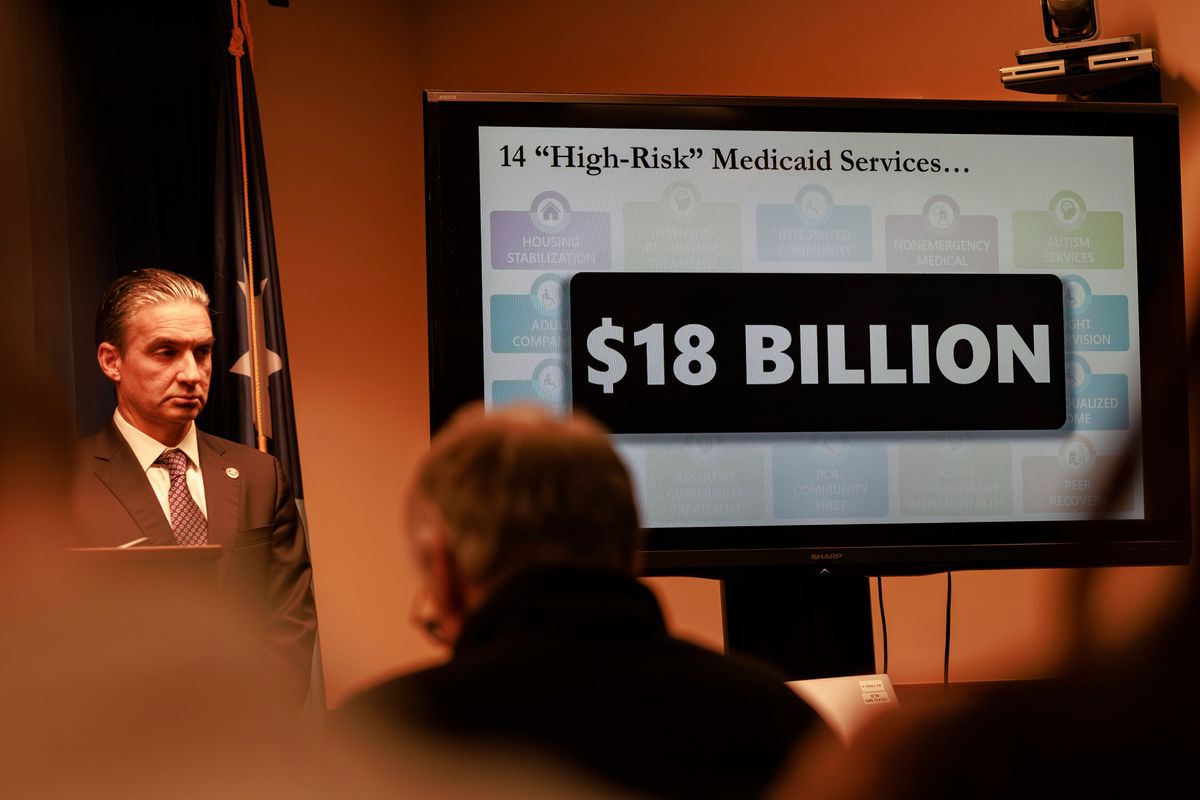
Half or more of the roughly $18 billion in federal funds that supported 14 Minnesota-run programs since 2018 may have been stolen, First Assistant U.S. Attorney Joe Thompson told reporters Thursday. Fraud was found in programs for things like child nutrition, housing services and autism.
“I’m sure everyone is wondering how much of this $18 billion was fraud,” Thompson said. “That’s the $18 billion question.”
The sprawling case has also become politically and culturally fraught, as Somali Americans make up 82 of the 92 defendants charged so far, according to the U.S. Attorney’s Office for Minnesota.
President Donald Trump has capitalized on that fact to target the Somalia diaspora in Minnesota, which has the largest Somali population in the U.S., as well as the state’s Democratic leadership. Local community leaders have urged officials and the public not to stigmatize Somali Americans in the state, warning against conflating alleged crimes by a handful of defendants with more than 80,000 people of Somali descent in the Twin Cities.
“Fraud is an issue of individual wrongdoing, not community identity,” said Yusuf Abdulle, the Minneapolis-based imam who directs the Islamic Association of North America.
The new fraud estimate comes after years of investigation that began with the Feeding Our Future scam, first announced in 2022 under the Biden administration, when 47 defendants were charged with allegedly pocketing $250 million of federal funds intended to feed children during the pandemic.
The Minnesota fraud cases have snowballed, and Thompson said more charges are expected.
How big are the losses?
While prosecutors previously accused defendants of stealing hundreds of millions of dollars, not the billions announced Thursday, they say they are finding new depths to the patterns of fraud.
The Minnesota Department of Human Services identified 14 state-run programs as high risk because of program vulnerabilities, evidence of fraudulent activity or suspicious billing patterns. Thompson said investigators are seeing more red flags than legitimate claims and that many suspects created entities that billed multiple programs at once.
Because fraud is inherently a “hidden crime,” the U.S. Government Accountability Office’s Rebecca Shea said investigators use imprecise estimates. She said plenty of fraud goes undetected altogether.
Attempts to scam government programs are rare but likely becoming more common nationwide, according to Linda Miller, president and co-founder of the Program Integrity Alliance, a nonprofit focused on fraud prevention in the public sector.
Fraudsters saw how easy it was during the pandemic “to just submit these fake invoices and get paid millions of dollars,” Miller said. “There’s very likely people attempting to defraud these programs all over the country.”
The blame game
The risk of fraud increases when programs expand quickly without sufficient staffing, modern technology or robust data verification systems, said Miller, a former assistant director with the GAO.
“We still have programs that assume trust, and we don’t have anything like the infrastructure to deal with all these people who are exploiting that most basic vulnerability,” she said. “It’s a ‘trust-and-don’t-verify’ system.”
In response to the investigations, Minnesota Gov. Tim Walz in October ordered a third-party audit and paused payments to the 14 programs for 90 days. One program has since been shut down entirely.
Walz says the state aggressively increased resources for fraud detection and prevention, and recently appointed a statewide director of program integrity to oversee those efforts.
Still, Trump and other Republicans have blamed Walz’s administration, with Trump calling Minnesota under the Democratic governor a “hub of fraudulent money laundering activity.”
Fraud beyond Minnesota
The Minnesota cases are unfolding against a broader backdrop of federal concern about fraud across government programs, especially since the COVID-19 pandemic, when there was “unprecedented fraud,” Shea said.
Based on data from 2018 through 2022, GAO estimated that the U.S. government loses between $233 billion and $521 billion each year, roughly 3% to 7% of the federal budget, to fraudulent activity. In their report, GAO investigators said “no reliable estimates of fraud losses affecting the federal government previously existed.”
In March 2023, the White House Office of Management and Budget cast doubt on those figures, saying they implied an “implausibly high” level of fraud. Shea said the GAO analysis intentionally included years with and without pandemic spending, and a wide range of annual losses reflects those variable conditions.
Other pandemic-era fraud examples include scammed unemployment aid, which the GAO said likely cost at least $100 billion. The Small Business Administration’s Office of Inspector General estimated that the agency distributed over $200 billion in pandemic relief loans to potentially fraudulent actors.
Earlier this year, federal prosecutors announced what they described as the Justice Department’s largest health care fraud case by loss amount. Nineteen people were charged for allegedly submitting nearly $11 billion in false Medicare claims for urinary catheters, activity that prosecutors attributed to a transnational criminal organization.
Recovering stolen funds
Even when authorities identify fraud, recovering stolen taxpayer money can be slow and incomplete.
Thompson said authorities have seized between $60 million and $70 million connected to the Feeding Our Future case. About $30 million of that amount is liquid cash or funds recovered from bank accounts.
The remaining assets include real estate and vehicles that must be sold, often at auction, and that process can take months or years.
Court records show Feeding Our Future defendants spent millions on homes in the Minneapolis metro area, lakefront property elsewhere in Minnesota and real estate in other states, including Ohio and Kentucky. Prosecutors said luxury purchases included more than $88,000 on a GMC truck, $93,250 on a Porsche and over $100,000 on a Mercedes.
Some of the money, however, is permanently lost. Prosecutors said defendants spent funds on travel, entertainment and services that cannot be recovered, including a lavish honeymoon trip to a private villa in the Maldives and the purchase of a suite at a Minnesota Timberwolves game.
Authorities also face obstacles retrieving money tied up in overseas accounts or foreign property. In one plea agreement, a defendant forfeited an apartment in Nairobi and an oceanfront resort in Kenya, court records show.
___
Associated Press reporter Giovanna Dell’Orto contributed from Minneapolis.
By HANNAH FINGERHUT
Associated Press