




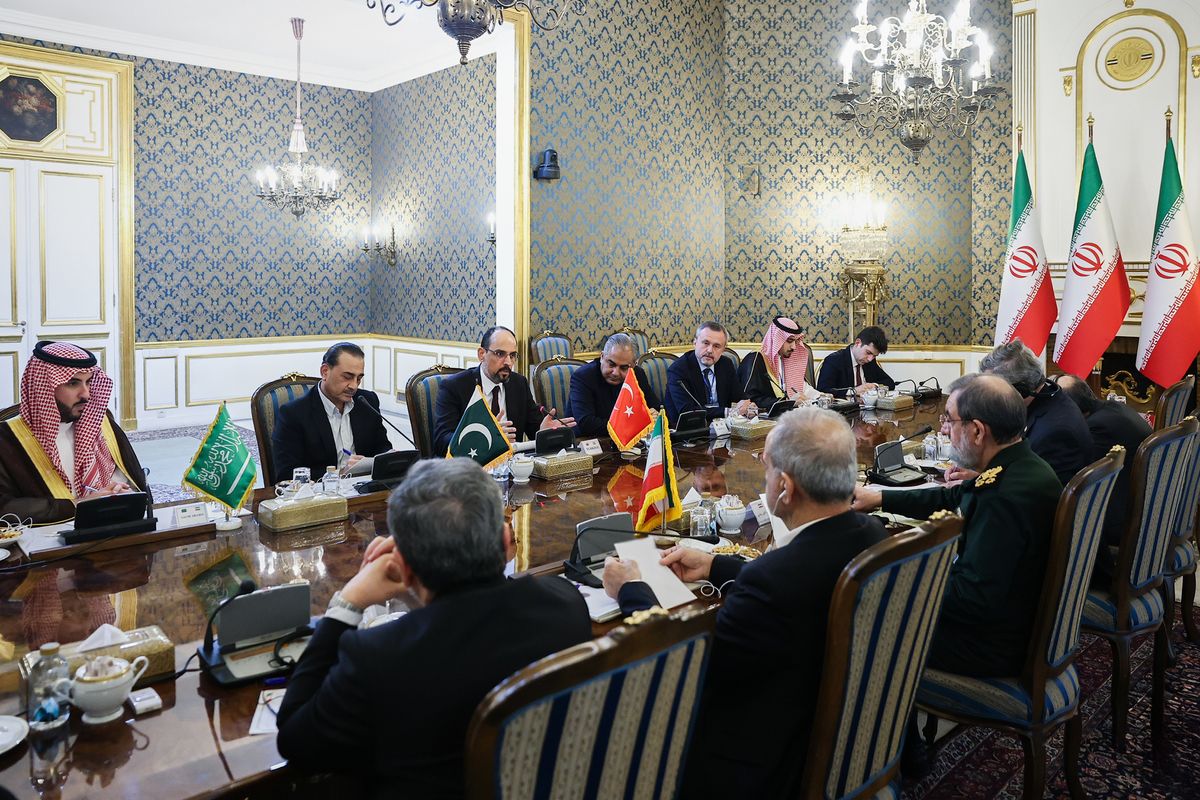
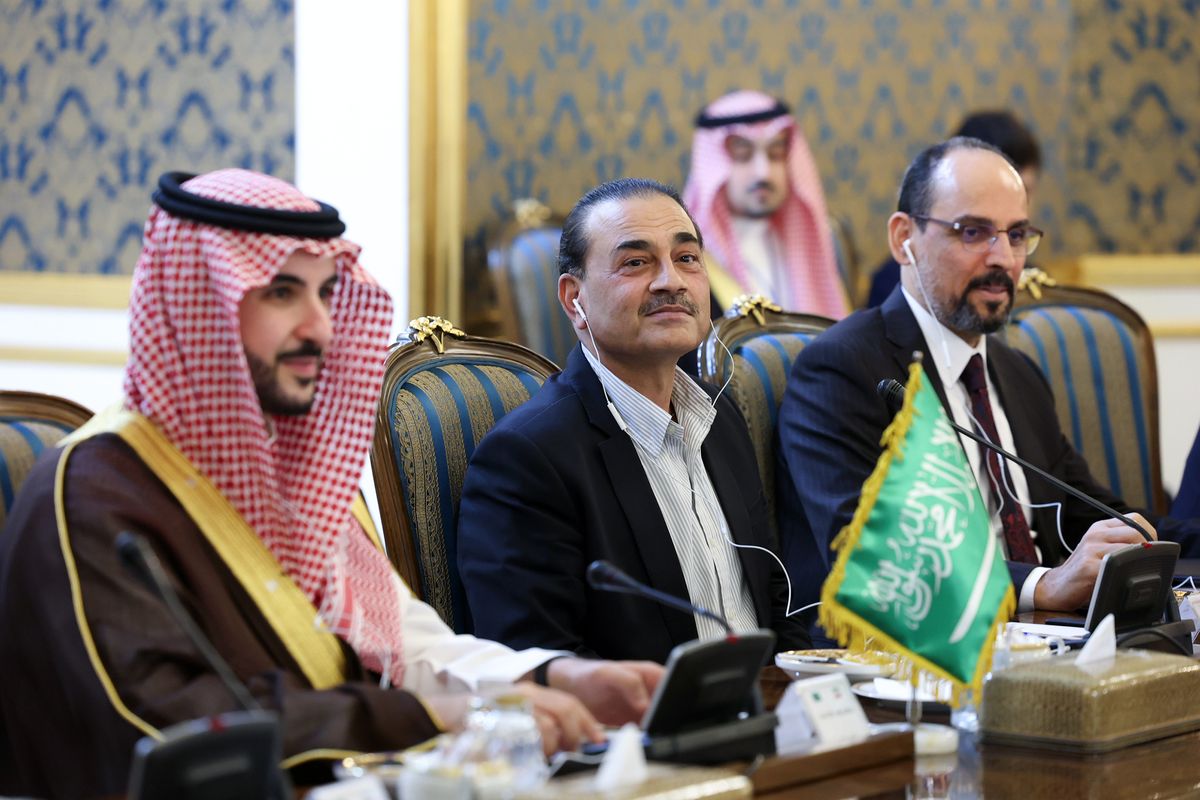
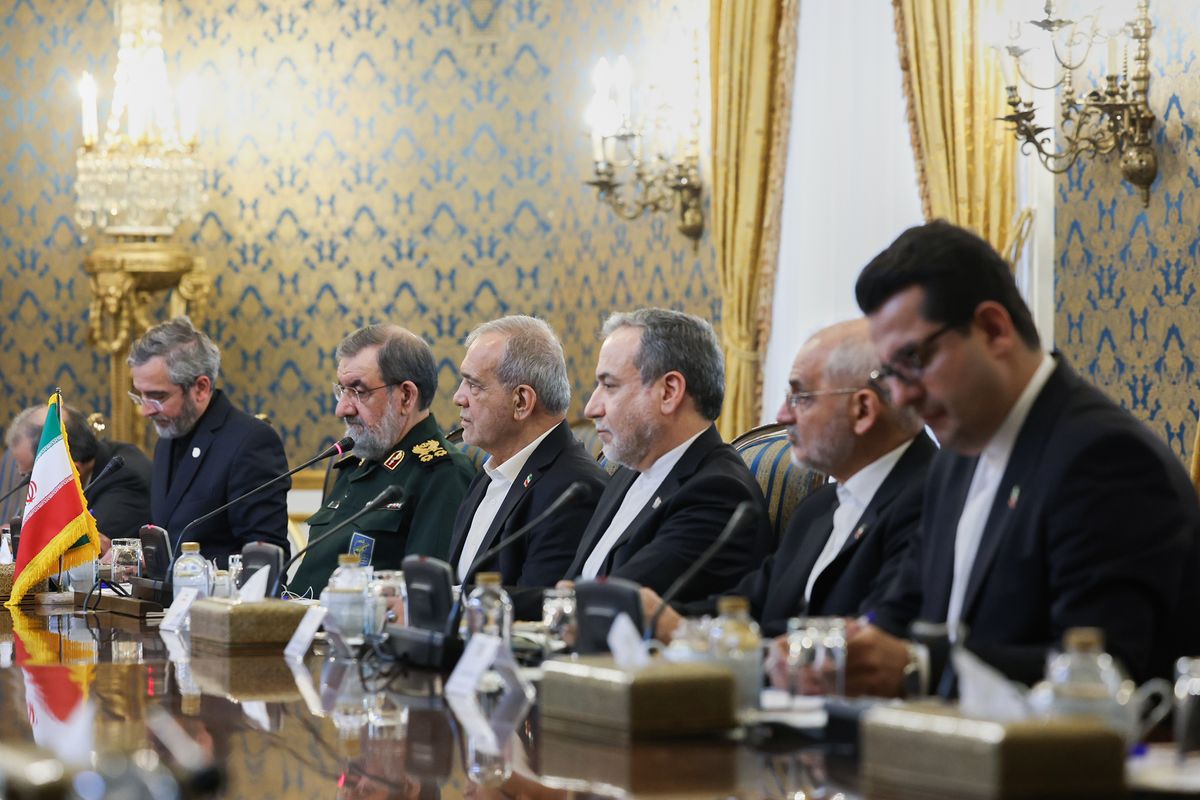
CAIRO (AP) — High-level delegations from Saudi Arabia, Pakistan and Turkey were in Tehran on Monday for meetings with Iranian authorities to try to avert renewed fighting in the Iran war.
Many in Iran are anxious about a possible return to all-out war. Israeli and American leaders have been sharpening their threats before elections in both countries, while Iranian leaders have remained defiant.
The war in Yemen and strikes by Iran-backed Houthi rebels against Saudi Arabia were also discussed, according to two regional officials who spoke on condition of anonymity because they weren’t authorized to speak with reporters.
The four countries agreed Monday to continue talks on expanding cooperation among them, particularly about regional peace and security, a statement said. No details were given about a date or place for a future meeting.
Saudi Defense Minister Khalid bin Salman, Pakistani army chief Field Marshal Asim Munir and Ibrahim Kalin, the head of Turkey’s intelligence service, attended the talks, hosted by Maj. Gen. Mohsen Rezaei, secretary of Iran’s Supreme National Security Council.
Iranian President Masoud Pezeshkian said Monday that Iran supports any agreement that would deepen regional cooperation, resolve differences and make greater use of the shared resources and capabilities of Islamic countries.
Delegations from the other Middle Eastern countries sought to avoid further turmoil in the region.
Turkish President Recep Tayyip Erdogan warned in a televised address on Monday that renewed attacks on Iran would destabilize the region and hurt countries that aren’t party to the conflict.
“It is our hope that all parties will refrain from any actions that could drag our region into a new spiral of violence,” Erdogan said.
Saudi Arabia said in a statement that the delegations hoped to find “ways to de-escalate tensions, enhance regional security and promote its stability.”
Qatari mediators also traveled to Tehran on Sunday, working in coordination with the United States, as part of efforts to de-escalate regional tensions, according to a regional official speaking on condition of anonymity because of the sensitivity of the talks.
Pakistan and Qatar helped broker an agreement in June aimed at having Iran fully reopen the Strait of Hormuz to shipping, ending a U.S. blockade of Iranian ports and opening negotiations on a broader settlement addressing Iran’s nuclear program. The deal unraveled quickly, however, as both sides renewed attacks.
Iran and Israel trade accusations
With worries about renewed fighting before Israel’s election on Tuesday and the U.S. midterm election on Nov. 3, Iranian Foreign Ministry spokesperson Esmail Baghaei said over the weekend that Iran hadn’t closed the window of diplomacy and that messages were being passed to the U.S. through intermediaries.
With negotiations long stalled, he said that the U.S. appears to be persisting in unilateral demands and that U.S. President Donald Trump and other American officials repeatedly use the phrase “complete surrender,” which Baghaei said no Iranian accepts.
Israeli Prime Minister Benjamin Netanyahu, meanwhile, repeated his warning on Sunday that Iran or its proxies could launch an attack before the election to disrupt the vote, citing intelligence.
“The (military) is ready both to defend and to strike,” he said in a video statement. “You will suffer disproportionate blows far greater than you can imagine.”
Israel’s Channel 12 reported Sunday night that Netanyahu and his military chief of staff clashed over an instruction by Netanyahu to carry out an “action” that the army believes could quickly trigger a resumption of the conflict with Iran.
Netanyahu’s office later described the report as “fake news.”
In Tehran, when asked whether Iran was planning attacks, Baghaei on Monday said that “the Israeli regime is highly skilled at carrying out false-flag operations.”
“The Islamic Republic of Iran will not hesitate to exercise its inherent right to self-defense to protect Iran’s sovereignty, territorial integrity and independence,” he said.
Front in the Iran war widens
Yemen has become a widening front in the Iran war that began in February, with the Houthis increasingly launching attacks on Saudi Arabia because it supports Yemen’s internationally recognized government battling the rebels.
The conflict has intensified since forces from the internationally recognized government and Saudi-led coalition launched airstrikes on Houthi-held Sanaa International Airport in July, shattering a 2022 ceasefire deal that largely stopped the fighting in Yemen’s civil war.
Early Monday, Houthi military spokesperson Yahya Saree said that the rebel group had fired ballistic missiles at military gatherings and weapons depots belonging to Saudi-backed government forces in Aden and Lahj provinces. He said that the attacks destroyed military equipment and caused casualties, but didn’t provide evidence. The Associated Press couldn’t independently verify the information.
Houthi media said that airstrikes targeted a solar power system and a water well in Sanaa, but offered no proof. In the port city of Mokha, recently seized by the Houthis, residents said that rockets hit several buildings, including a hospital.
Doctors Without Borders, or Médecins Sans Frontières, said Monday that three strikes hit Mokha, one landing just 150 meters (nearly 500 feet) from Mokha General Hospital, where its teams work in maternity and pediatric wards.
The statement came after the Houthi-run Health Ministry accused Saudi-backed forces of targeting the hospital. The Saudi-backed forces haven’t commented.
All staff and patients were safe, MSF said, adding that the strike damaged the hospital building.
Days earlier, a missile struck near Aden’s airport as an MSF plane carrying humanitarian workers was preparing to take off, forcing staff to seek shelter instead of boarding, the organization said. Aden’s airport is the main entry point for humanitarian workers, supplies and medical equipment to the southern parts of Yemen.
Houthi-run al-Masirah channel also reported strikes in Saada, in northern Yemen, and in southwestern Taiz province, where the rebels and Saudi-backed government forces have been fighting for weeks.
The spokesperson for the Saudi-led coalition said that an operation in Houthi-controlled territory destroyed five tunnels used for storing ballistic missiles, four ballistic missile launchers and other missile storage.
Meanwhile, Egypt’s parliament on Monday approved a request from President Abdel-Fattah el-Sissi to provide military support to Saudi Arabia to help defend against Houthi attacks.
___
Victoria Eastwood and Fatma Khaled in Cairo, Natalie Melzer in Tel Aviv, Israel, Munir Ahmed in Islamabad, Ahmed al-Haj in Aden, Yemen, and David Rising in Bangkok, contributed to this report.
By SAMY MAGDY
Associated Press