




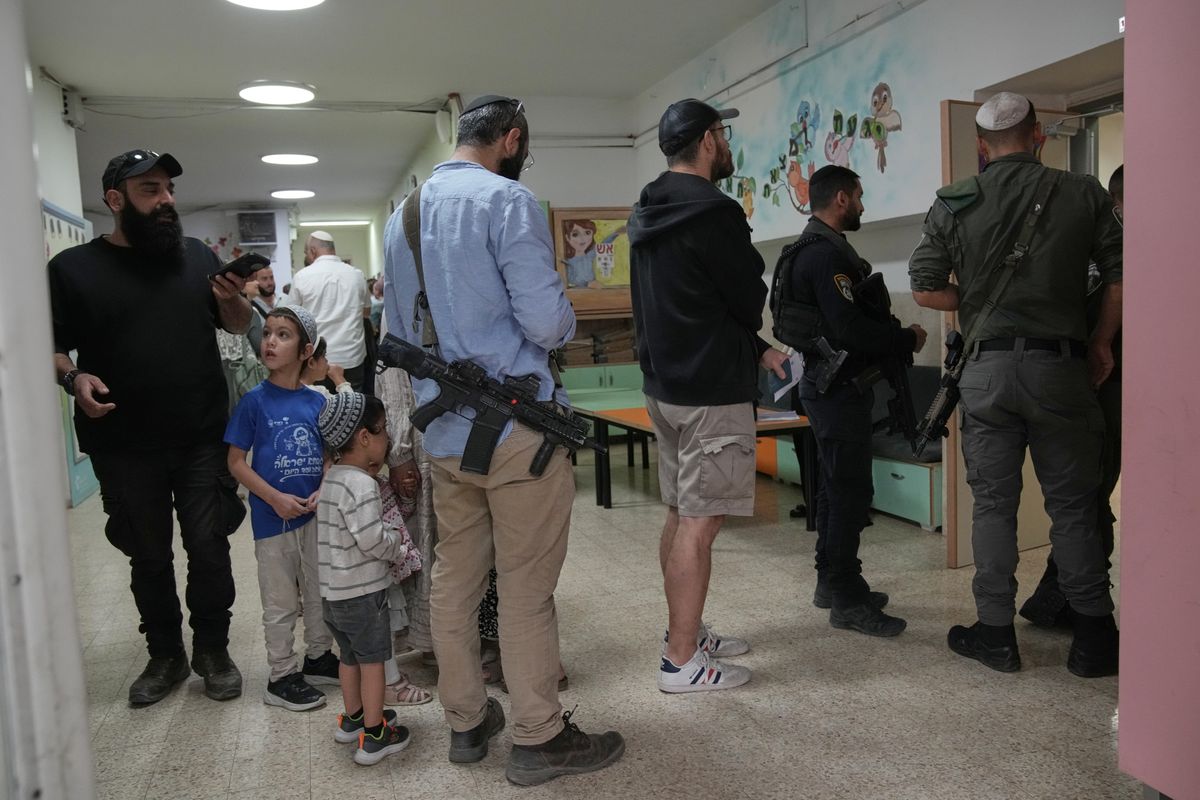
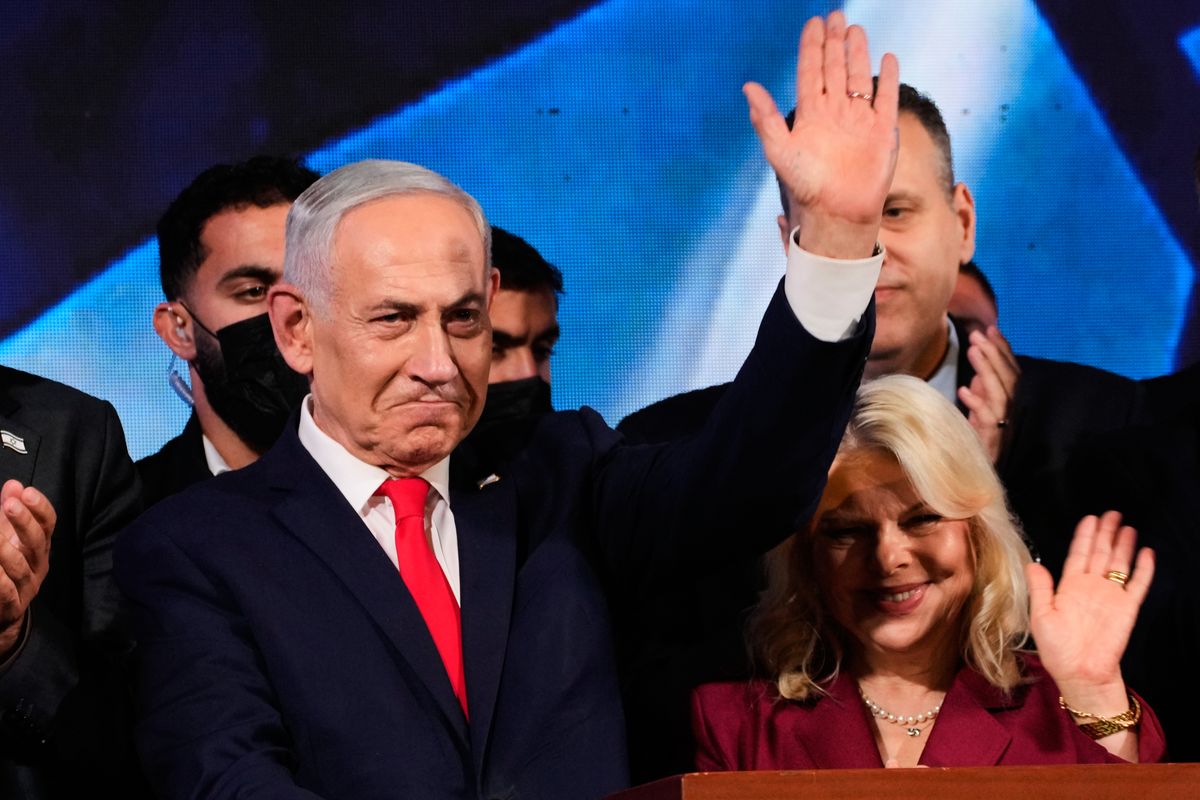
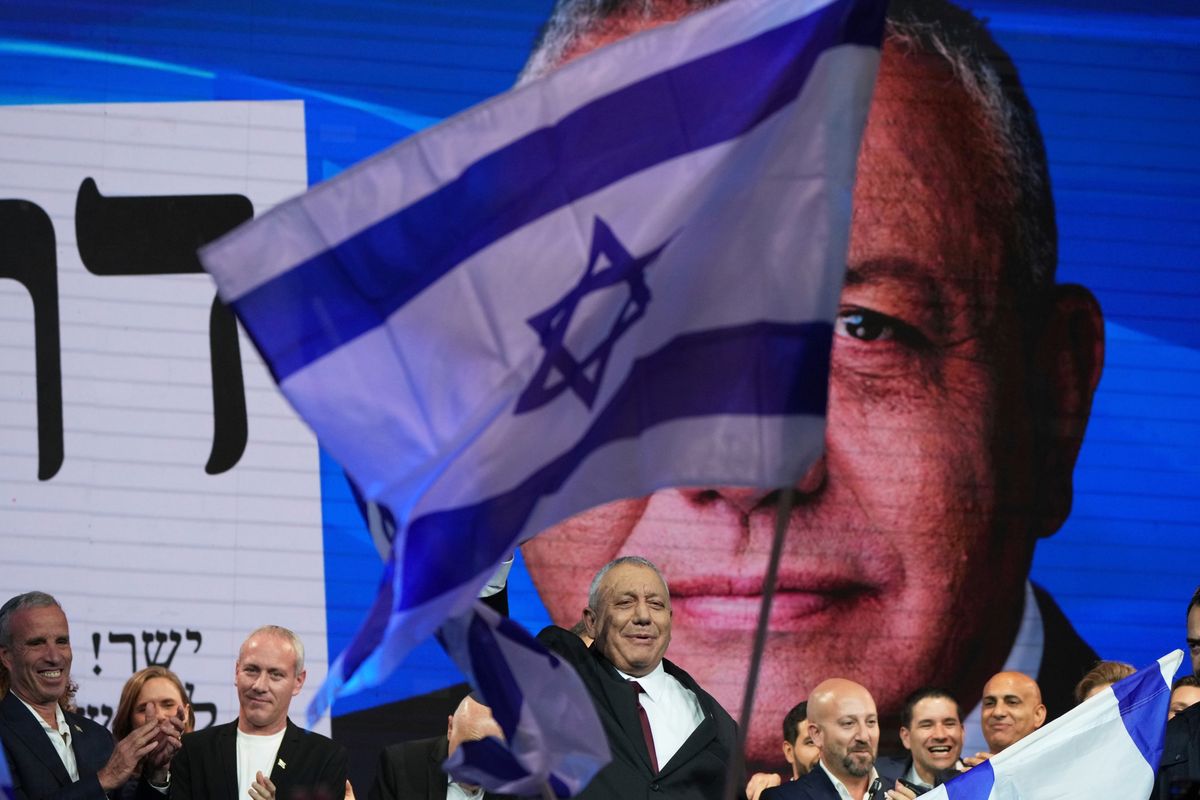

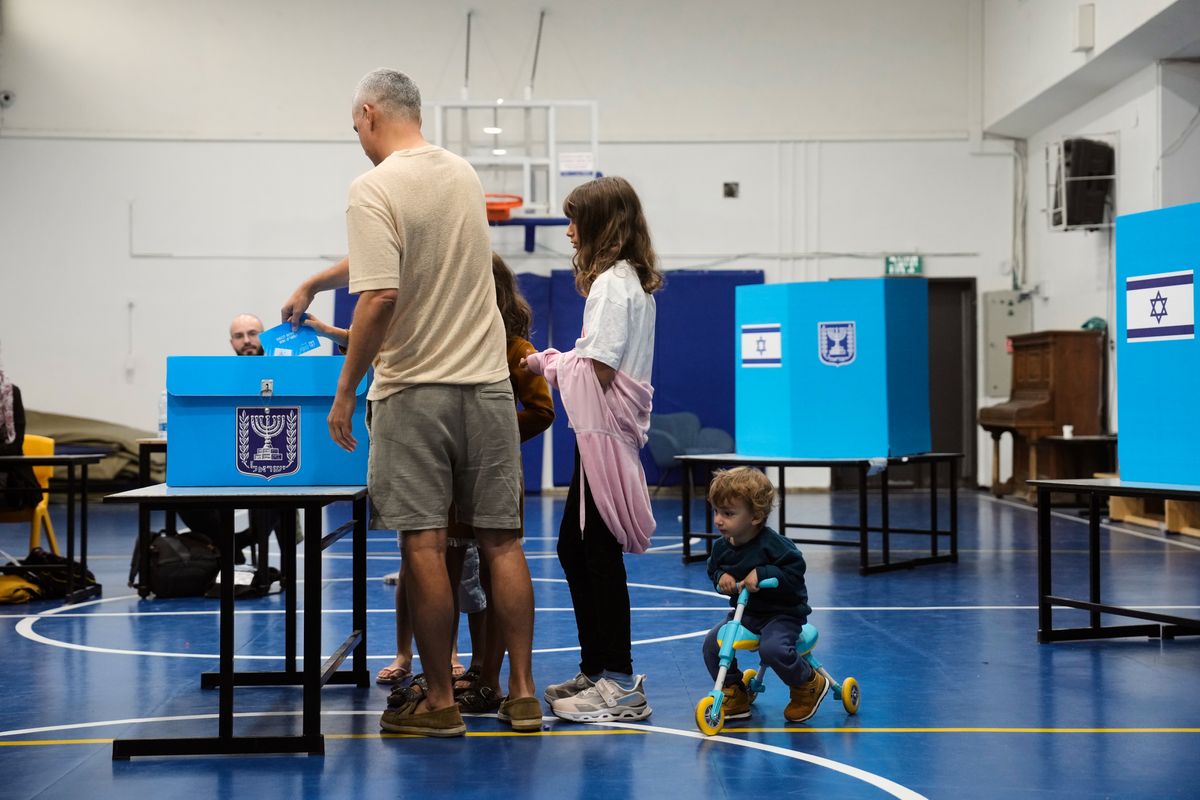
There was no clear winner Wednesday in Israel’e election, likely meaning the beginning of weeks of wrangling among parties to form a governing coalition. Prime Minister Benjamin Netanyahu remains as interim caretaker head of the government.
Neither Netanyahu’s political bloc nor that of his main rival, former military chief Gadi Eisenkot, appeared likely to gain the 61 seats needed for a majority in the parliament, known as the Knesset. Israelis vote for parties, which then form alliances to create a majority coalition.
Here is the latest:
Local media are projecting seat breakdowns
Voting percentages are one thing. But in Israel, where parties form coalitions to obtain a majority of the 120 parliamentary seats to govern, the number of seats is key.
As vote-counting nears its end, local media are projecting 53 seats for Netanyahu’s Likud and allied parties, 48 for Eisenkot’s Yashar and allied parties, and 19 for Arab-led parties.
Under those projections, no one reaches the 61-seat majority alone. Final results are expected by the end of the week.
Israel’s president explains next steps
President Isaac Herzog has a key role in choosing someone to put together the next government. Here’s what he said today about next steps: “I will receive the official election results next week, when (the deputy president of the Supreme Court) presents them to me. I will then begin the process of the consultations here, hearing from each and every faction, asking questions, and holding discussions.”
He added: “One thing must be clear, and I said this before the elections too: We must do everything we can, certainly after yesterday, to avoid another round of elections. So I expect everyone who comes here to come with an open mind.”
The president usually chooses the leader of the party with the most votes to put together a government, but isn’t required to do so.
Residents of one Arab city hope for change
In Nazareth, one of Israel’s largest Arab cities, the emerging election results bring some hope.
Brosli Elias called the preliminary results indicating a strong showing for Arab-led parties excellent: “God willing, we will have something for us in the government, something that will bring us our rights.”
Residents cited rising crime and more job opportunities as central issues, but Awni Zoabi also thanked God for a possible return to rationality in a country where extreme rhetoric has increased.
“You walk around today, and they don’t want you in certain places to speak in the Arabic language,” Zoabi said. “The Arabic language has become as if it were a crime.”
Head of one Arab-led party speaks out
Yousef Jabareen, leader of the Joint List of Arab parties, is calling for a “true and equal” Jewish-Arab partnership to help oust Netanyahu’s government after a strong showing by Arab-led parties.
“Against a government of bloodshed, against politics of supremacy, racism and exclusion, we offer a completely different alternative,” Jabareen wrote in an X post that was deleted within minutes.
Arab-led parties have long served in opposition to a system they believe is fundamentally unfair. Until 2021, none had joined a coalition government.
People in Gaza don’t expect much to change
People in Gaza were following the election results closely, hoping that anyone but Netanyahu will form the next government.
“All of their policies toward Gaza are tough, but we choose the lesser of two evils,” said resident Ayman Ahmed, who hoped that main challenger Gadi Eisenkot would prevail.
Mohammed Abed said he didn’t expect major changes no matter who is in power.
“An Eisenkot victory will not dramatically change the situation, because their policies are almost similar,” Abed said. “In the end, it will be the same.”
Israelis don’t know what comes next
Jerusalem resident Ran Cohen says Netanyahu should assemble a governing coalition because “he’s the only one who knows how to do the job properly, knows how to speak to the world.”
Also in Jerusalem, Moshe Meri Cohen says Netanyahu and chief rival Eisenkot should form a unity government because Netanyahu “is a diplomat and Eisenkot brings a fresh perspective. Both are important.”
And Uzi Levy believes there will be another election to sort things out, “and then the people will come to their senses and choose correctly.”
Mixed reactions to Israeli elections in the occupied West Bank
A headline in one Arabic-language newspaper in the occupied West Bank says: “Arabs bring down Netanyahu.”
However, votes are still being counted and emotions are mixed after a significant showing by Arab-led parties.
Palestinians in the West Bank had no vote on Tuesday, but they watched as Israel’s Arab citizens did.
“The Israeli elections will not change anything,” said Khaled Shawar al-Tamimi in Hebron. “The two major parties, Yashar and Likud, are two sides of the same coin.”
But Fahed Ahmro from Hebron hoped for “a government of law that lifts the injustice that has befallen us over the past three years or during the previous regime of this oppressive and unjust government.”
Oman’s top diplomat warns Israel over Iran
Oman’s foreign minister says that whoever is chosen as the next Israeli leader, they should “leave Iran alone” and focus on finding a just resolution to the Palestinian question.
With tensions high in the region over the possibility of renewed American or Israeli attacks on Iran, Omani Foreign Minister Badr al-Busaidi told Britain’s Channel 4 News on Tuesday that he hoped Iran and the United States would return to the negotiating table.
“I don’t know really what is now expected out of Iran,” al-Busaidi said, adding that in his mind, the issue of Iran’s nuclear program had been resolved based on what he had heard from the Americans, and that “the facilities have been bombarded and everything has been eliminated.”
Israelis who flew home to vote have mixed feelings about the inconclusive results
Some Israelis who flew thousands of miles to vote in their country said they’re dismayed that after the Oct. 7, 2023, Hamas-led attack, so many voters could still support Netanyahu.
“I’m disappointed,” said Tamar Ichilov, who flew in with her partner from Toronto.
If no candidate is able to form a coalition government and there’s another election, she’ll fly back again.
Others, like Eti Wissotzky-Cohen, were more hopeful. The 44-year-old who settled last year in Britain with her family to get away from Israel’s wars said the initial polls show there is no alternative but to include Arab parties in the government. “This would open the door to repairing our society and building a just and equal society, while preserving Israel as the national home of the Jewish people,” she said.
Iran remains a question
Lost for the moment in the focus on vote-counting is the unsettled issue of further strikes against Iran.
There remain concerns among some analysts and others in Israel that Netanyahu could press for strikes and try to rally other political leaders into a unity government.
Eisenkot in his speech early on Wednesday warned Netanyahu “not to use Israel’s security for your political needs” while he is a caretaker prime minister.
Iran’s government has not commented on Israel’s election since the polls closed.
No statements this morning from top candidates
There’s been no public word from Netanyahu or Eisenkot as it approaches noon in Israel.
They were up into the early morning hours addressing supporters. The two rivals and their teams, like the rest of Israel, are also trying to make sense of the results as vote-counting continues. Final results lie ahead, perhaps as early as Thursday.
Voters wrestle with the Arab issue
Hanna Doukhan, a voter in Tel Aviv, said she feels “the country is pretty stuck.”
“We are little by little coming to a situation where we have to face reality,” she said. “I don’t see a possibility to form a government without the Arabs.”
But some called that a difficult thing to consider after decades of friction.
“A peace won’t be between Muslims and Jews. Never,” said another voter in Tel Aviv, Artsi Wine, who nevertheless acknowledged that “we have to find a way to live together.”
60% of votes have been counted
With 60% of votes counted, Netanyahu’s Likud party has 21.4% and Eisenkot’s Yashar has 16.2%, according to official election data.
The count released on Wednesday morning from Israel’s Central Elections Committee does not indicate how many seats each party will win in the parliament.
Israelis face difficult questions around the strong Arab vote
With Arab parties’ strong showing in the election and the possible implications of that in forming a new government, Israelis are facing a debate as strong as their morning coffee.
An analysis in the left-leaning Haaretz news outlet indicated an important moment for any political grouping that considers itself democratic.
“A situation in which Israel’s Arab citizens go to great lengths to participate in a political arena that relentlessly strives to exclude them, only to be met with another slap in the face, bodes poorly for the future of the bloc that styles itself as ‘democratic,’” it said.
Attention will turn to Israel’s president
Israel’s president’s role is largely ceremonial, but not once election results come in.
President Isaac Herzog soon must choose the person he believes is best placed to form a government and set them to work. That person usually is the head of the party with the most votes.
Netanyahu’s Likud has the most votes with half of them counted, but tasking the party with the most votes is not required.
And some in Israel might argue that considering how sharply polarizing his government has been, another choice might help in the coalition-building period ahead.
Israel’s military says there was an almost 80% turnout among its personnel
Hundreds of thousands of votes cast by members of Israel’s military have yet to be counted, but the military says turnout among its ranks was 79.9%.
That’s up by more than six percentage points from the previous election. Some polling stations had been set up in combat areas.
A guard shoots and kills attacker armed with knives outside Israel’s Embassy in Serbia
Serbian police say that an unidentified assailant attacked a guard with knives outside the Israeli Embassy in Belgrade and was killed early on Wednesday.
Serbian Interior Minister Ivica Dacic says police are treating the incident as a “terrorist attack” and have raised the terror threat to the highest level and stepped up police presence at key locations.
Dacic said the attacker was a minor and had two knives. He attacked the guard, shouting Allahu Akbar, or “God is great” in Arabic.
He added that the police officer “liquidated” the assailant in “self-defense” and was lightly wounded.
Trump says he heard Netanyahu ‘did pretty well’
U.S. President Donald Trump on Wednesday disputed the notion that Netanyahu may be heading toward defeat as exit polls indicated no clear winner in Israel’s elections.
“I’m hearing that he did very well,” he told reporters at Joint Base Andrews, Maryland, after returning from a pair of campaign rallies in Texas. “I actually heard he did pretty well.”
Trump cautioned that it was a “little bit early” and said he has not yet spoken with Netanyahu about the results. Trump endorsed Netanyahu late in the campaign, while Netanyahu stressed his close ties with the White House in his election night speech.
By The Associated Press