




World shares and U.S. futures advanced Monday after artificial intelligence stocks recovered some ground lost in last week’s sell-offs.
In early European trading, Germany’s DAX climbed 0.6% to 25,974.42, and the CAC 40 in Paris was up 0.4%, at 8,168.36. Britain’s FTSE 100 rose 0.4% to 10,720.81.
The future for the S&P 500 was up 0.3% and that for the Dow Jones Industrial Average climbed 0.6%.
Taiwan’s Taiex led gains in Asia with a 4.9% jump, thanks to a rebound in computer chipmaker TSMC, which surged 4.7%.
Regional tech stocks benefited from Friday’s rally in the U.S., where AI stocks got some relief from their sell-offs earlier in the week on worries that Democratic victories in the midterm elections could slow construction of AI data centers, particularly in Texas. Voters across political parties say they are wary about AI and don’t like increases to power bills caused by data centers.
Investors also are watching to see what the Democrats’ sweeping victories will mean for markets and the broader economy.
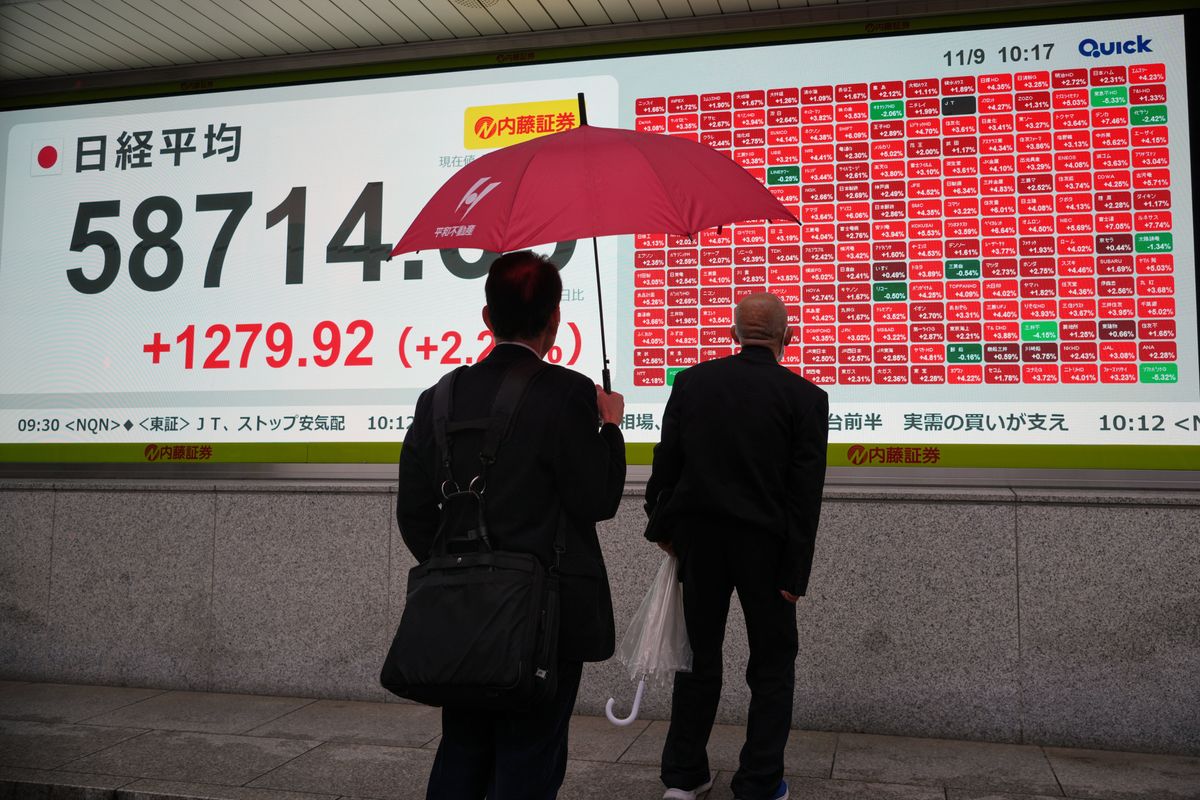
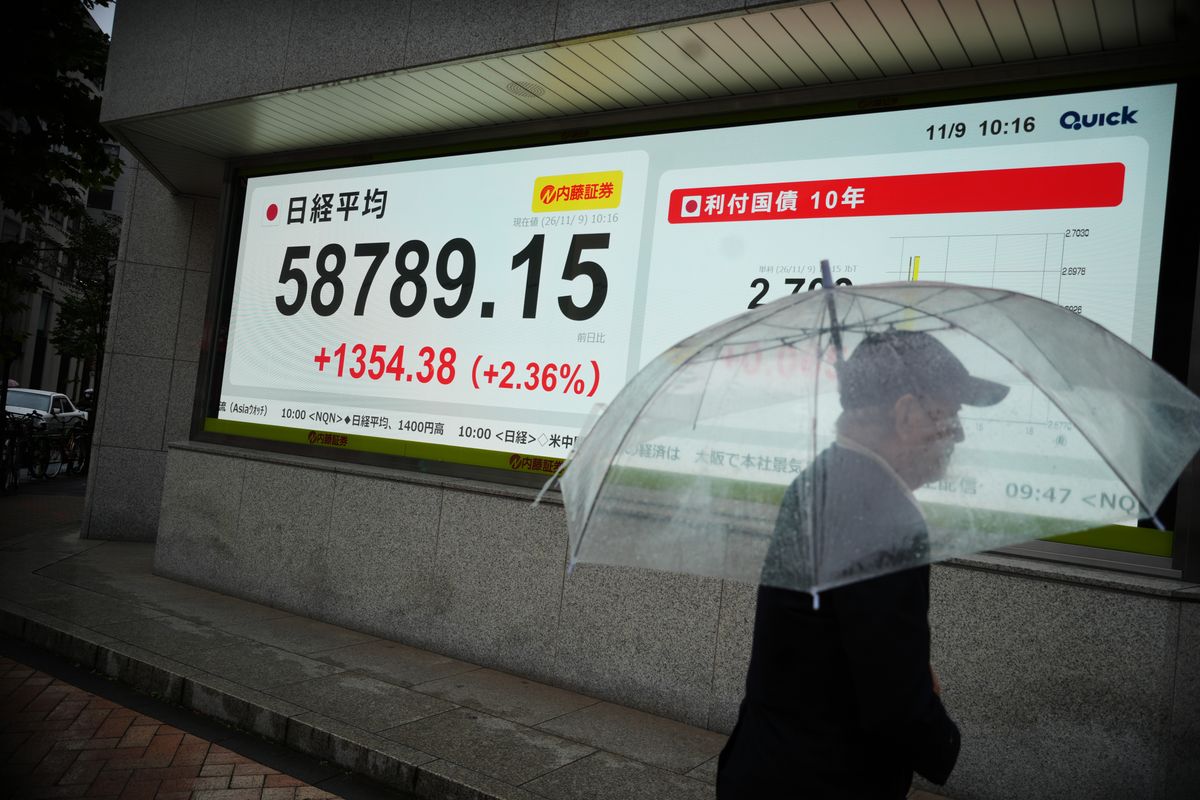
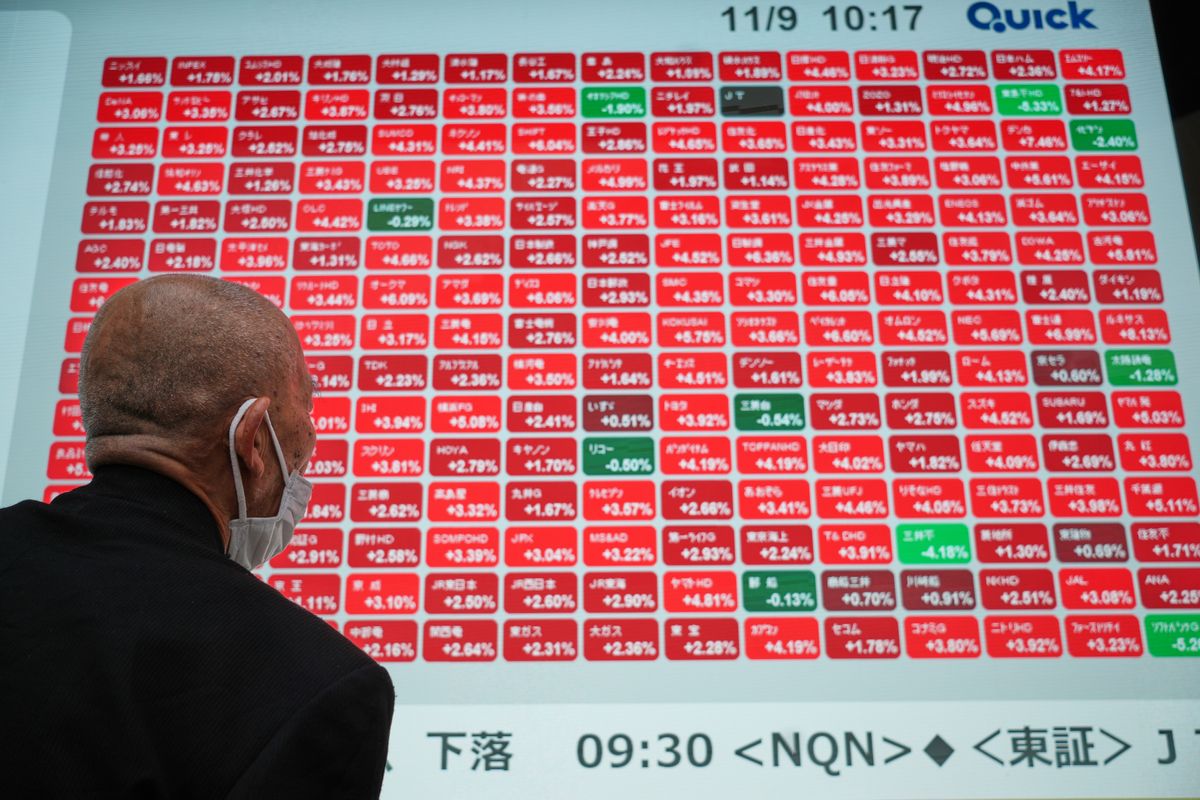
Monday trading started out strong in Tokyo, where the Nikkei 225 index closed 2.3% higher at 58,775.50.
Chip equipment maker Tokyo Electron climbed 2.8%, giving up bigger gains earlier in the day, while Advantest, which makes testing equipment, was up 1.3%.
SoftBank Group’s shares fell 4.2% as the company maneuvered to salvage a $5.4 billion robotics deal with Switzerland’s ABB that Chinese regulators have rejected.
In South Korea, the Kospi fell back after rising in the morning, shedding 0.8% to 5,018.85. Samsung Electronics Corp. gained 0.6% and chipmaker SK Hynix rose 0.4%. Those are very modest gains for companies whose share prices have yo-yoed as investors dumped and then snapped up AI-related shares over the past few weeks.
Elsewhere in Asia, Hong Kong’s Hang Seng edged 0.1% lower to 24,448.95. The Shanghai Composite index added 0.3% to 3,660.79.
Australia’s S&P/ASX 200 edged 0.1% higher to 9,029.70.
On Friday, the S&P 500 rose 0.3% and trimmed its loss for the week to 2.7%, which was its worst since U.S. President Donald Trump shook markets in April 2025 with his “Liberation Day” tariffs. The Dow Jones Industrial Average dropped 0.5%, and the Nasdaq composite climbed 1.1%.
The relative steadiness halted what had been a worldwide tumble for stocks. Indexes dropped 6% in Tokyo and in Seoul following Wall Street’s plunge on Thursday.
Friday’s biggest lift for the S&P 500 came from Nvidia, the chip company that has become the face of the boom and possible bust of the AI frenzy. Its stock climbed 2.8%, coming off drops of 9.3% and 3.2%.
Nvidia said Sunday it was opening an investigation into reports that CEO Jensen Huang was the target of a foreign intelligence effort. That followed Huang’s acknowledgment that he had been intimate with a business executive who, according to The New York Times, U.S. intelligence determined was gathering information for China.
During a routine briefing Monday, China’s Foreign Ministry dismissed the spying allegations, calling them a smear campaign against Beijing.
Nvidia’s share price fell 4.1% in premarket trading early Monday.
Nvidia is a central player in the race to develop artificial intelligence. Its chips power many of the data centers and computing systems used to train and run AI models. Its advanced processors have also been a focus of U.S. export restrictions aimed at limiting China’s access to cutting-edge semiconductor technology.
“The scrutiny surrounding Jensen Huang reaches far beyond a personal scandal, touching the increasingly sensitive intersection of U.S. technology leadership, China and national security,” Stephen Innes of SPI Asset Management said in a commentary.
Despite its recent gyrations, the S&P 500 is only 5.7% below its all-time high, which was set last month.
A report released Friday showed U.S. employers hired many more workers last month than economists expected, in the latest signal that the U.S. economy is chugging along despite high inflation.
In other dealings early Monday, Brent crude oil, the international standard, slipped 2% to $96.38 per barrel. U.S. benchmark crude fell 1.5% to $89.56 per barrel.
The U.S. dollar slipped to 158.09 Japanese yen from 158.36 yen late Friday. The euro rose to $1.1188 from $1.1142.
By ELAINE KURTENBACH
AP Business Writer