




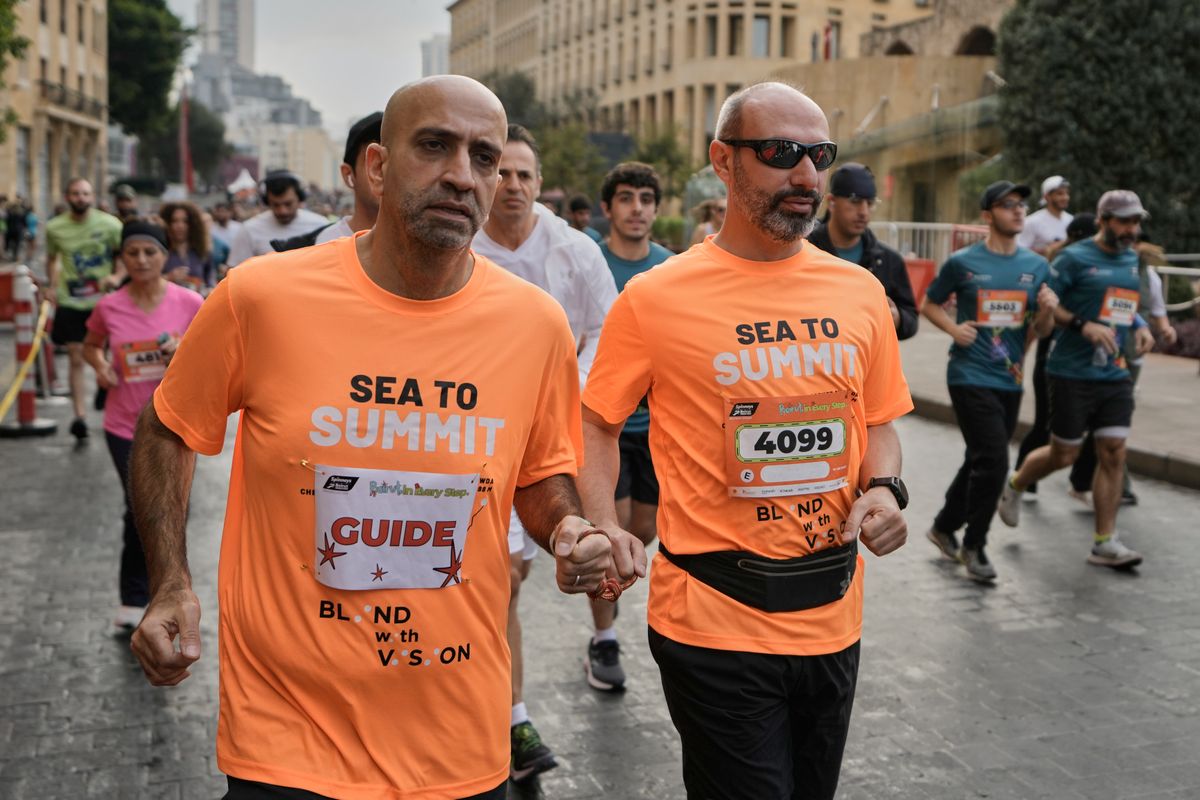
BEIRUT, Lebanon (AP) — Holding opposite ends of a short rope, two men crossed the finish line Sunday at an annual Beirut road race, breathing heavily. One wore sunglasses. As they approached, the other leaned toward him and whispered that they were almost there.
The man in sunglasses, Rabih Al-Jammal, is blind. He had just completed the 10-kilometer (6.2-mile) race, running tethered to a sighted guide.
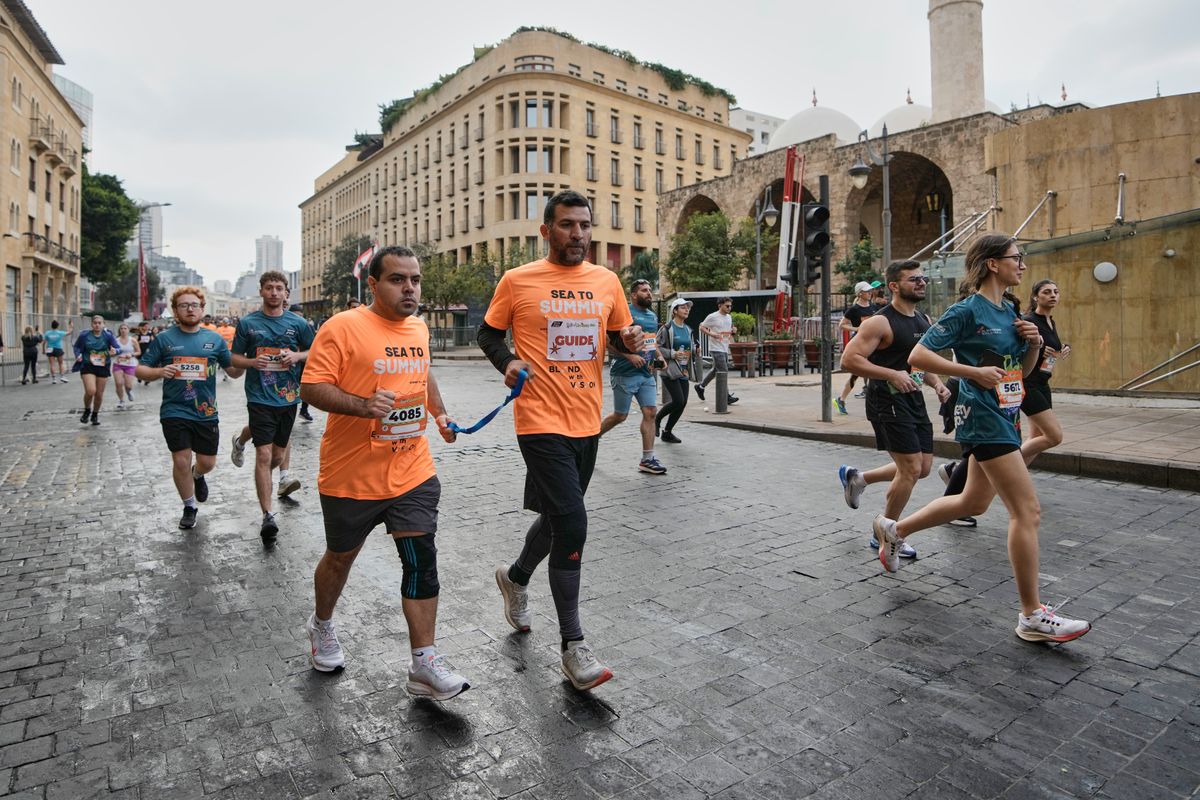
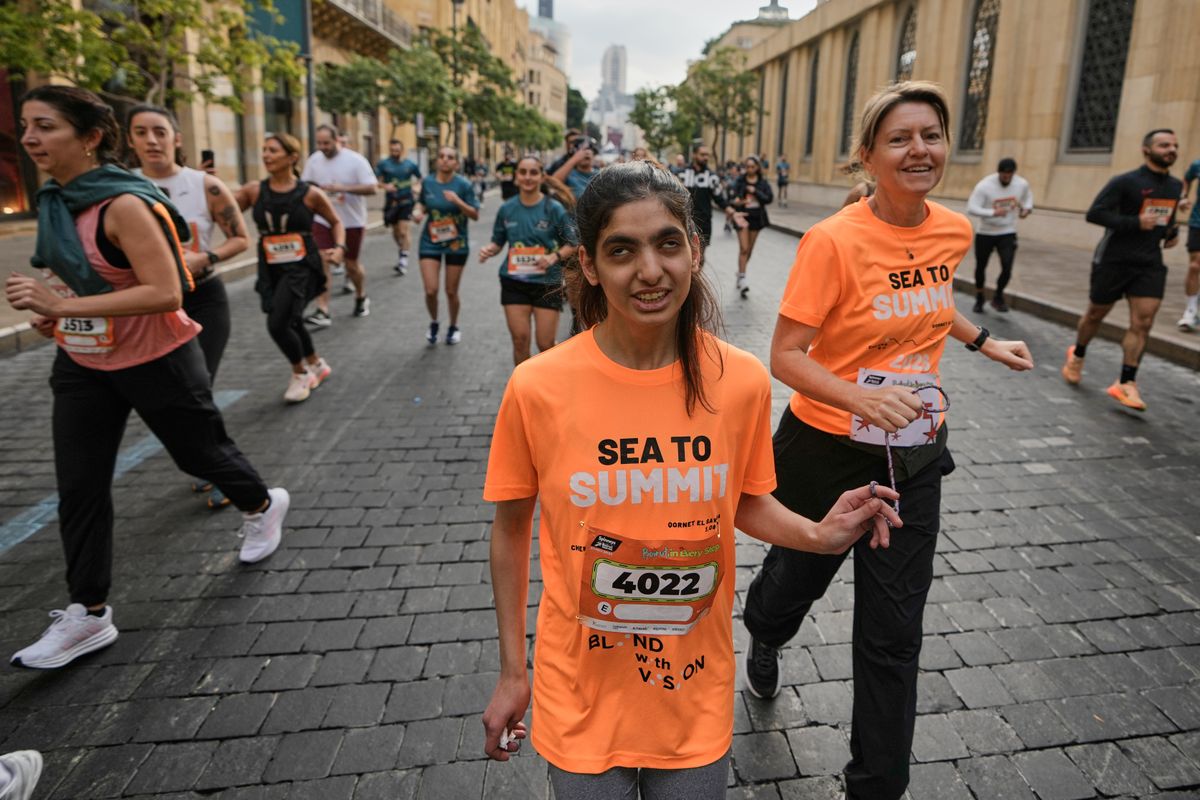
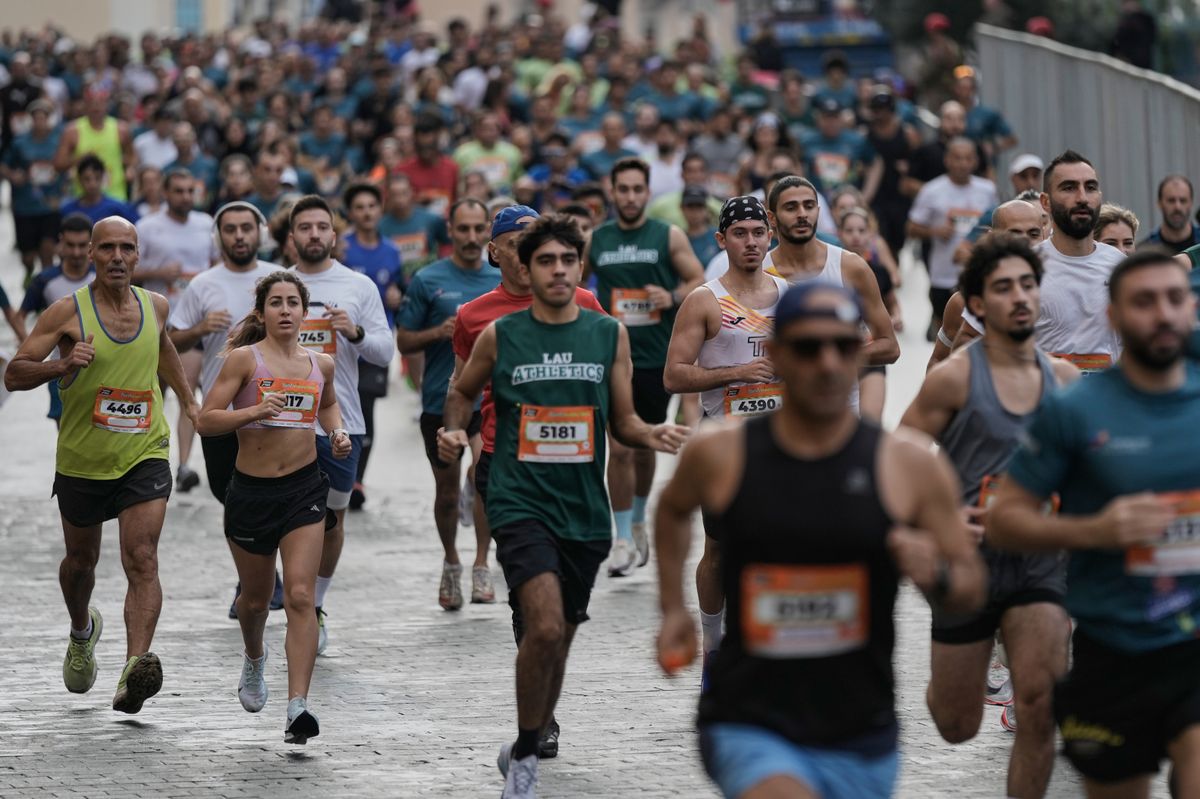
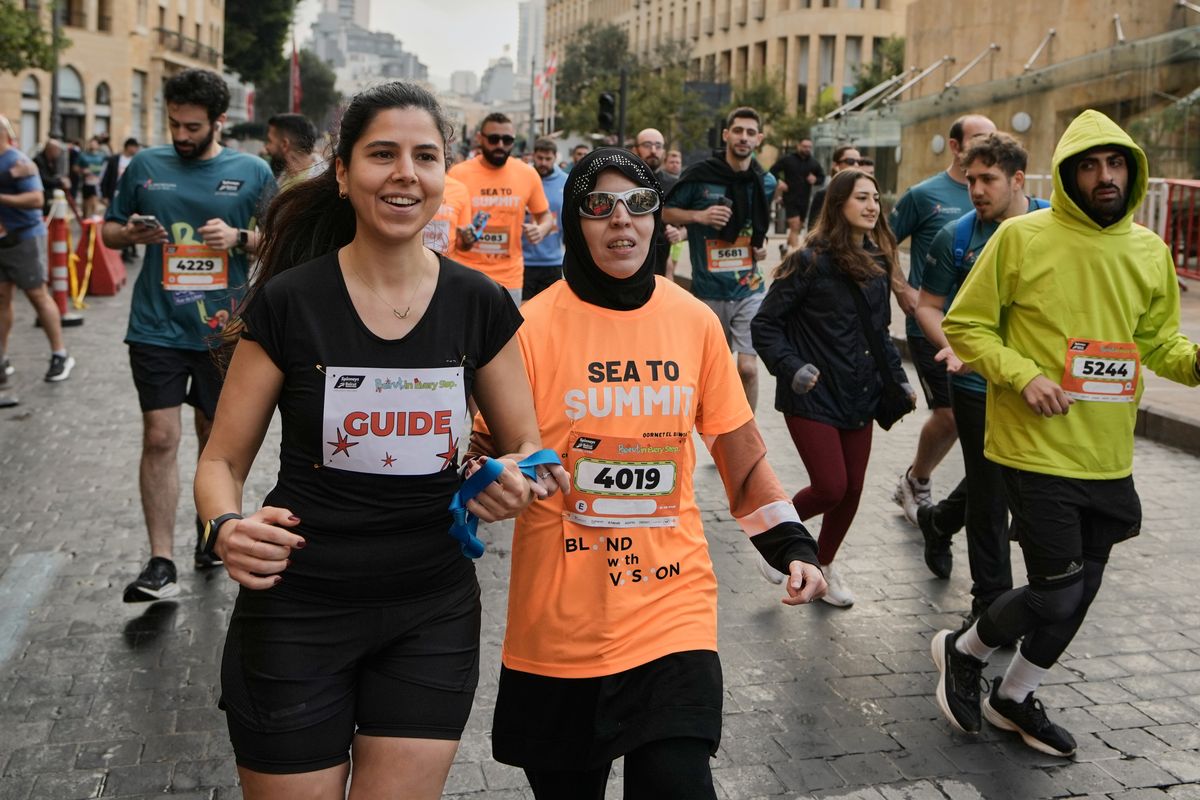
Al-Jammal was one of 12 visually impaired runners competing in the 10- and 6-kilometer (3.7-mile) races as thousands of other runners took to Beirut’s streets for the annual 26.2-mile (42.2-kilometer) Beirut Marathon. The visually impaired runners competed despite rain and thunder, with sighted guides from the Lebanese non-governmental organization Blind with Vision.
Al-Jammal, 40, remembers watching the first Beirut Marathon on television in 2003, about a year before he lost his sight as a result of glaucoma, a condition that damages the optic nerve, potentially causing gradual vision loss. He listened to the coverage in the years that followed, dreaming of one day crossing the finish line. In 2016, he decided to start out with a 7-kilometer (4.4-mile) walk.
Friends and well-wishers came to cheer him on, among them Mary Kleyany, an experienced runner, coach and mountaineer who was moved by his determination.
“I told her I want to run the 42 (kilometer race), to which she replied, ‘I’m with you,’” Al-Jammal said.
Kleyany spent six months training with him, learning how to guide a blind runner, using a rope inspired by her mountaineering experience to connect them. In 2017, Al-Jammal became the first visually impaired Lebanese man to complete Beirut’s full marathon, according to the Beirut Marathon Association.
With Kleyany guiding him, he went on to run the Rome Marathon in 2018 and complete a triathlon in Lebanon, combining swimming, cycling on a tandem bicycle and running.
Their partnership eventually grew into Blind with Vision, which has since helped other visually impaired athletes take on races and outdoor challenges, Kleyany told The Associated Press.
Runners challenge their disability
Despite the rain-soaked course and a few slips, Dania Barbour, 42, completed her second 10-kilometer race Sunday, tethered to guide Christina Elias, a 32-year-old financial consultant who has volunteered with the group for three years.
“For me, running is a dream achieved. It helped me believe that I can challenge my disability,” Barbour said.
Fady Al-Homsi, 45, described his guide, Wassim Nsouli, as his eyes for the day. Al-Homsi lost his sight completely at 33 after living with retinitis pigmentosa, a disorder that damages the retina, since childhood.
He has pushed himself since then to take on challenges that many would assume are out of reach for someone who doesn’t see. He works as a music instructor for people with special needs, is studying music therapy, and volunteers with the Lebanese Civil Defense.
In four years of running, he has competed in several road races, a half-marathon and a 21-kilometer trail run in Lebanon’s mountainous Aakoura region.
“I’ve lost my sight, but this doesn’t mean I can’t run. It doesn’t mean I should stay home. I am like anyone else. So we should unleash this hero inside us,” he said.
Nsouli, a Lebanese Red Cross member, found the group two years ago through social media and “got hooked after the first time” volunteering, he said, later wrangling other friends into joining.
The two communicated throughout Sunday’s race.
“He helped me, and I helped him,” Nsouli said. “I tell him when I’m tired, when there’s a turn left or right, or to watch out for a puddle to his left. A woman stopped to take a picture, I told him to move around her.”
The cash-strapped Lebanese government has lurched from one crisis to another for years. Providing resources for people with disabilities has largely been left to families and NGOs.
Blind with Vision “offered me a safe space,” said Nasser Ballout, 33, who was born blind and competed Sunday.
Group pushes through challenges
Kleyany recently left her office job to make the initiative her full-time commitment.
“I have not run any race for myself since 2017,” she said. Instead she spends her time training runners, guiding them during races and coordinating events.
Keeping the group going comes with challenges. Kleyany said it faces a shortage of guides and has no regular funding. Volunteers contribute their time and expertise to management, media and logistics, while the group relies on occasional in-kind sponsorships.
The group has also taken on challenges beyond the racecourse. In October, Blind with Vision organized a two-day Sea to Summit challenge, taking visually impaired athletes from the coast at Chekka in northern Lebanon to Qornet el-Sawda, the country’s highest peak at 3,088 meters.
The 68.5-kilometer journey involved relay stages along roads, through villages and across mountainous terrain.
“I wanted to check the sight from up there, but I couldn’t see anything,” Ballout joked, recalling the two-day challenge.
By SALLY ABOU ALJOUD
Associated Press