




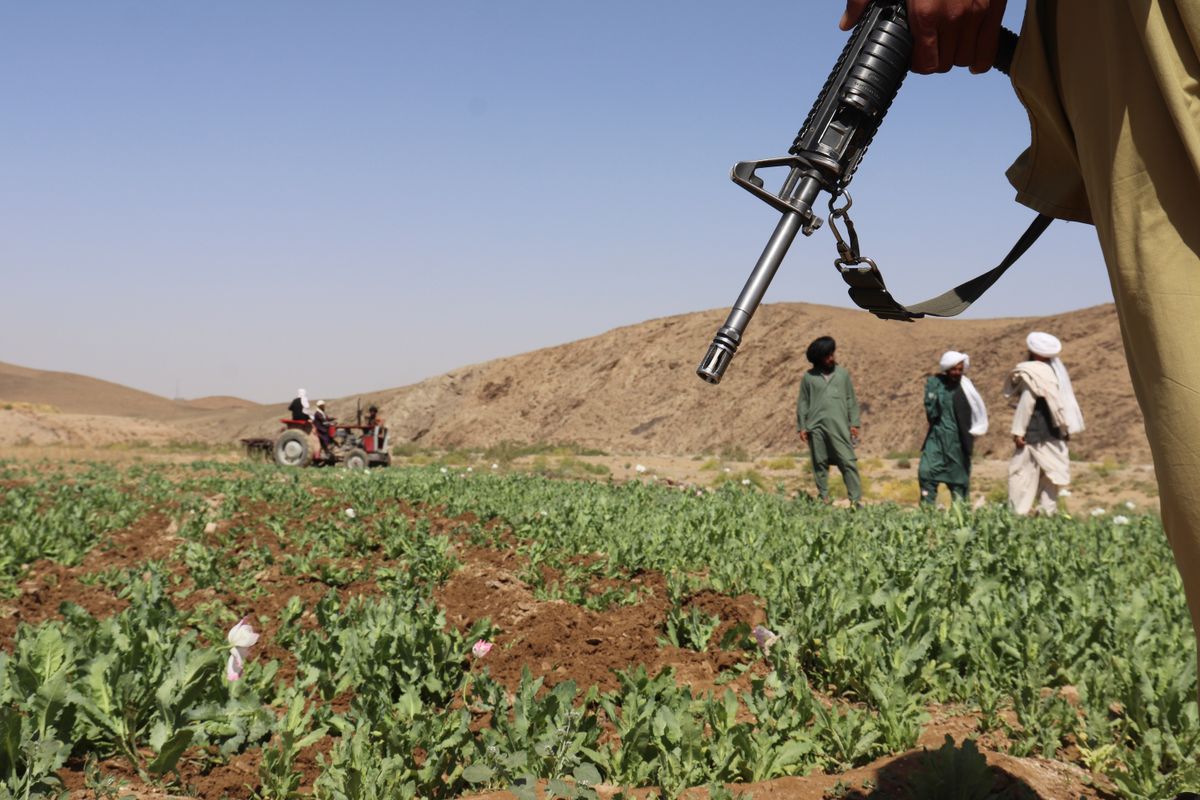
KABUL, Afghanistan (AP) — Poppy cultivation and opium production in Afghanistan rose sharply over the past year, the United Nations Office on Drugs and Crime said on Thursday, describing it as the first significant increase since the country’s Taliban rulers imposed a narcotics ban in 2022.
The agency attributed the rise to deepening poverty, which it said has driven some farmers to cultivate opium clandestinely. It called on the international community to provide support to farmers to help curb reliance on illicit crops.
Afghanistan was the world’s biggest opium producer and a major source of heroin in Europe and Asia when the Taliban seized power in August 2021. They pledged to wipe out the country’s drug cultivation industry and imposed a formal ban in April 2022, dealing a heavy blow to hundreds of thousands of farmers and day laborers who relied on proceeds from the crop to survive.
The U.N. agency said cultivation was up 330% and production rose by 400% compared to last year. Cultivation rose to more than 43,000 hectares (106,000 acres) in 2026 from 10,000 hectares (24,700 acres) a year earlier, it said.
Farmers were concealing small poppy plots within cereal fields or inside walled compounds to evade detection, the report said.
“The fourfold increase in opium poppy cultivation shows the difficulty in sustaining decreases in illicit opium cultivation when poor farmers have no alternatives to feed their families,” a statement quoted the agency’s executive director, Monica Juma, as saying.
“The (Taliban authorities) and the international community need to work together to support farming communities by investing in livelihoods, farming infrastructure and access to markets,” she added.
The Taliban rejected the agency’s findings, insisting that the UNODC’s report had “not accurately reflected the actual situation and has overlooked the practical achievements of the fight against narcotics.”
It argued that the U.N. agency had relied on “satellite images, estimates and incorrect information from biased groups.”
“In 2026, more than 26,000 hectares of land in the provinces where cultivation had taken place were cleared of narcotic-producing crops,” a statement from the Interior Ministry said.
“These operations were carried out at considerable financial and human cost and under difficult field conditions,” it said. “Therefore, any assessment that fails to take these measures and their results into account in its calculations is incomplete and unfair.”
The U.N. agency said that while cultivation and production remained below levels prior to the 2022 narcotics ban, the increase was the highest since the ban came into effect. The agency said that continued monitoring was required as it was too early to determine whether the increase was temporary or an indication of the resurgence in opium cultivation and production.
Foreign Minister Amir Khan Muttaqi on Tuesday described the fight against narcotics as one of the Taliban administration’s greatest achievements. However, he also said the international community has a role to play to keep the drugs issue under control.
“An effective fight against this phenomenon is a shared responsibility of both Afghanistan and the international community,” Muttaqi said. “It is essential alongside security measures to support alternative livelihoods for farmers, provide treatment for those struggling with addiction, and enhance regional and international cooperation against drug-trafficking networks.”