




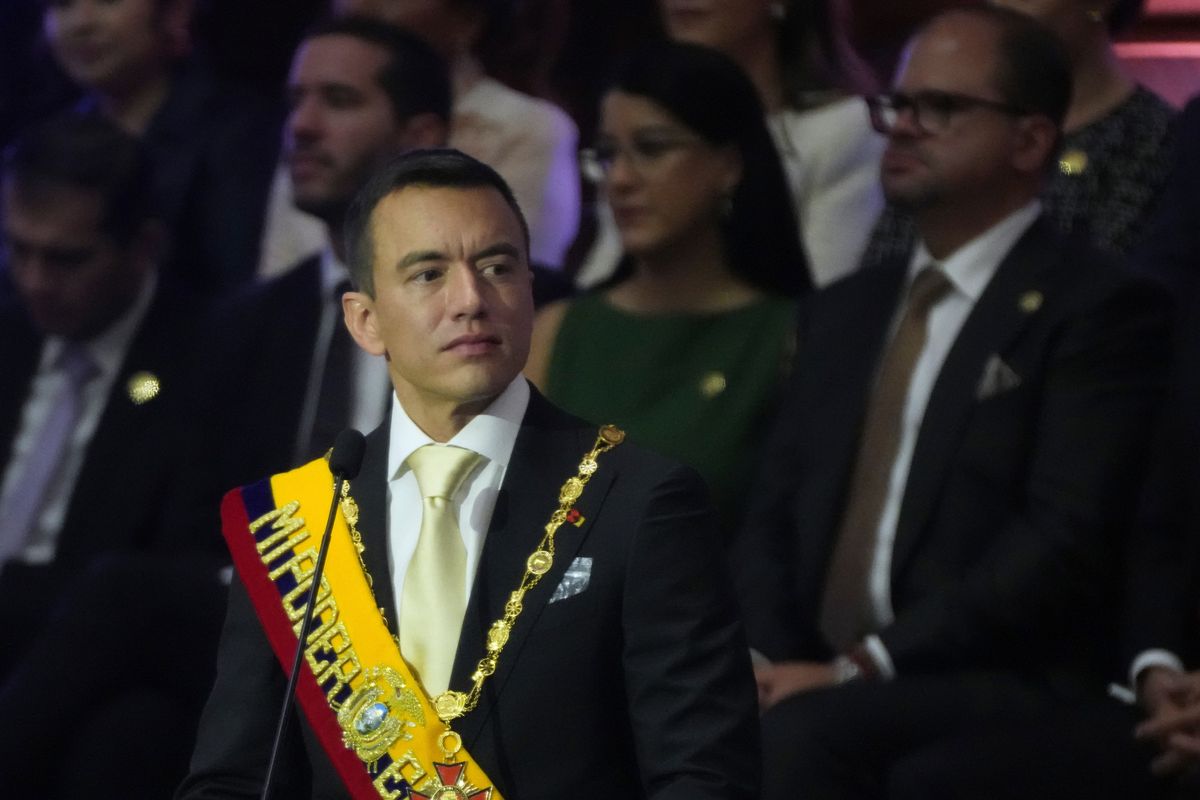
QUITO, Ecuador (AP) — Ecuadorian President Daniel Noboa’s government has hailed the extradition from Spain of crime boss William Alcívar as the latest success in its U.S.-backed campaign against organized crime. But analysts say that while progress has been made, violence persists and the government needs to broaden its approach and address education and social services.
Noboa’s government has waged a military campaign against criminal groups for nearly three years, capturing most of their leaders and extraditing some to the United States at the request of U.S. authorities, who accuse them of drug and arms trafficking, among other crimes.
Nearly all the leaders of the main gangs have been arrested: Adolfo Macías, alias “Fito,” of Los Choneros; Alcívar, of Los Tiguerones; Wilmer Chavarría, of Los Lobos, who was arrested in Spain at Ecuador’s request; and Julio Martínez, alias “Negro Tulio,” who was also detained in Spain. Those organizations are Ecuador’s most powerful and have been designated terrorist groups by Washington.
Following the arrests, organized crime is undergoing a major transformation in Ecuador, experts agree. But the record violence persists.
Over nearly six years, the Andean nation has become one of the most violent countries in the Americas, with 50.9 killings per 100,000 inhabitants. Last year, it recorded 9,216 killings, the highest figure in the country’s history.
Authorities say the violence stems from clashes between criminal gangs for control of drug trafficking routes and territory. According to international organizations, 70% of the cocaine consumed worldwide passes through Ecuador, which borders Colombia and Peru.
The criminal gangs
Colombian security analyst and consultant Hugo Acero told The Associated Press that when a criminal leader is removed, “divisions immediately emerge and different groups form. They splinter and begin managing smaller but equally lucrative revenue streams.”
Ecuador’s criminal violence burst into public view in early 2021 with a series of brutal massacres inside prisons. Authorities recognized 22 criminal gangs with about 18,000 members.
Since then, Ecuador has seen an “exponential growth in organized crime,” according to security expert and retired army Col. Mario Pazmiño, a former army intelligence chief.
“We now have about 50 groups with 80,000 members,” Pazmiño said.
In addition to drug trafficking, the gangs earn money from illegal gold mining, kidnapping and extortion.
Daniel Pontón, dean of the School of Security and Defense at the Institute of Advanced National Studies, said organized crime operations have become more sophisticated, seeking “strategies to go unnoticed and evade state control.” The groups have entered legitimate sectors such as finance and commerce to conceal their activities.
The government’s plan
In a recent speech, Noboa said Ecuador could not prosper “if families live in fear” and warned criminals that “we will hunt you down, we will find you and we will extradite you.”
The president has touted increased drug seizures, the capture of major crime bosses and the deportation of some of them to the United States as successes.
To confront the criminal onslaught, Noboa declared an internal armed conflict in January 2024, allowing the military to work alongside police to maintain public order.
He also ordered the military to take control of the largest prisons, which had become command centers for criminal groups. Authorities tightened controls at ports, airports and borders, particularly the border with Colombia, where they say most of the drugs entering Ecuador originate.
Pazmiño criticized the authorities’ military approach, saying “other kinds of measures” were needed. The state must restore its presence in vulnerable areas and provide “education, basic services and social security for the benefit of the community.”
Acero, for his part, said it was more effective to “attack the source of financing, criminal revenue and the way they launder the money” that funds criminal organizations.
Pontón said the executive branch must also promote “joint, coordinated action with the justice system” to bring criminals to justice. The government frequently complains of inaction or delays by the prosecutor’s office and the judiciary.
International military cooperation
Ecuador is part of the so-called Shield of the Americas, a hemispheric security coalition promoted by U.S. President Donald Trump to coordinate operations against cartels and criminal organizations in the Americas.
As part of that effort, the Andean nation has received U.S. financial, military and intelligence support, as well as personnel on the ground, from the United States, along with assistance from Italy, Israel and other countries.
But international assistance “will be short-lived, so Ecuador must develop its own tools to confront and resolve this problem,” Pazmiño said.
With the new Democratic majority in the U.S. Congress, “it is very possible there will be changes next year and that U.S. cooperation will begin to dwindle and could even be cut off entirely,” Pontón warned.
Human rights concerns
Joint military and police operations have drawn complaints from human rights organizations, which have reported arbitrary detentions, the deaths of people believed to be innocent during the operations, and disregard for laws and procedures.
The U.N. Committee on Enforced Disappearances has expressed concern over dozens of reports of enforced disappearances during the government’s campaign.
According to figures from the prosecutor’s office, 147 complaints alleging that military and police personnel exceeded their authority were recorded between January and July this year, the highest figure in a decade.
Ecuadorians still remember the case of four minors detained and tortured by soldiers in Guayaquil who were later found dead. Those responsible were given prison sentences from 11 to 15 years.
By GONZALO SOLANO
Associated Press