




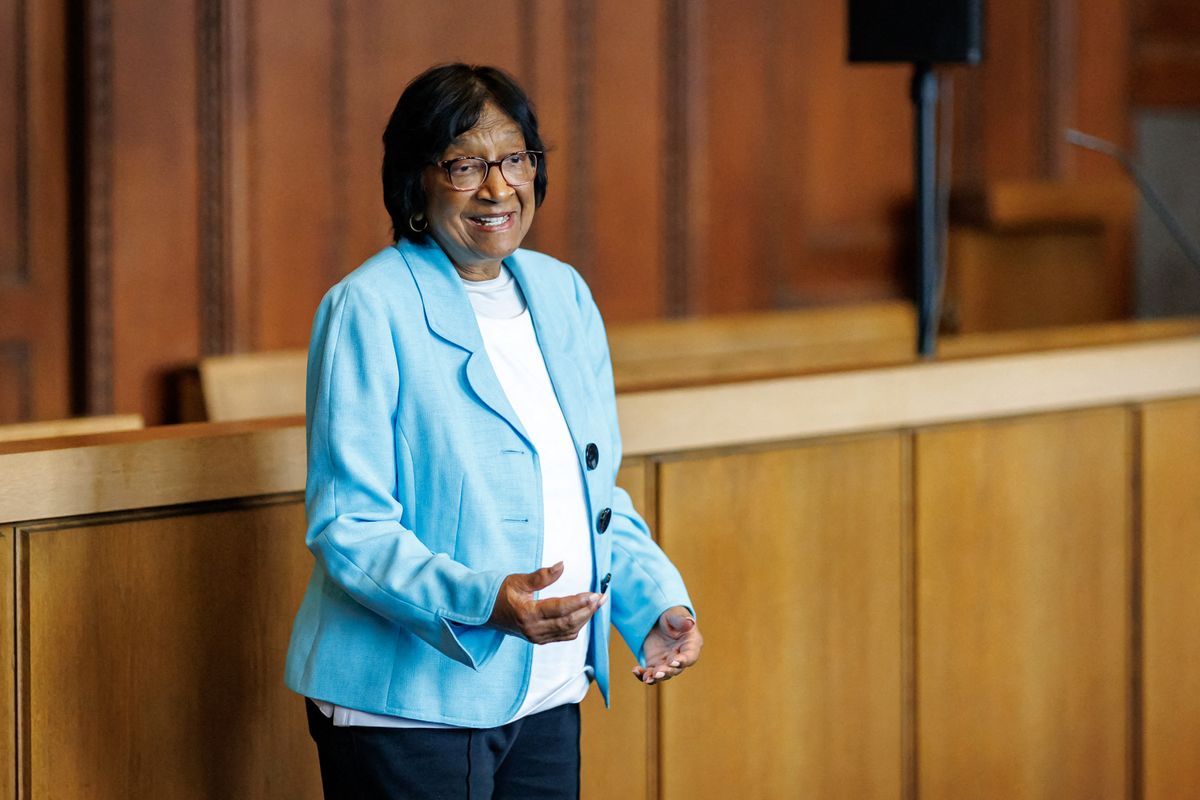
The Hague, NETHERLANDS (AP) — Navi Pillay, the veteran South African-born jurist who won the Nobel Peace Prize on Friday, made a name for herself defending the rights of Nelson Mandela and leading a panel that found that Israel committed genocide in Gaza.
She has also worked for years as a judge in international courts that have sought to deliver justice for atrocities such as the Rwanda genocide and to adjudicate divisive issues of law between nations.
Pillay, 85, heard she had won the prestigious award while attending a law forum in Nuremberg, Germany, the location of the trials of Nazi war criminals that helped lay the foundations of international law.
Pillay was one of the first judges at a court now under intense pressure from Trump
Pillay’s win brings renewed attention to U.S. President Donald Trump’s attacks on the International Criminal Court, where Pillay was a judge from 2003 to 2008.
The court was created in 2002 to be a last stop for the most serious international crimes, such as war crimes, crimes against humanity, genocide and aggression.
The United States and Israel are not members, but 125 other countries have signed the court’s foundational treaty, the Rome Statute. The ICC becomes involved when nations are unable or unwilling to prosecute crimes on their territory. The court’s newest member, Ukraine, formally joined in January.
Judges at the court have convicted 11 people. One of the cases that Pillay was involved with as an ICC judge centered on Congolese warlord Thomas Lubanga, the first to have been convicted at the court. He was sentenced in 2012 to 14 years in prison for conscripting child soldiers.
But Trump accuses the court of being anti-American and his administration has sanctioned 13 of the ICC’s staff members, among them key prosecutors and nine judges including the court’s Japanese President Tomoko Akane.
In his speech to the United Nations General Assembly last month, he urged member states to quit the “rogue institution immediately.” There are fears the court as a whole could be sanctioned, a move that could seriously hamper its ability to mete out justice.
She is currently serving as an ad hoc judge at the United Nations’ highest court
Pillay left the ICC in 2008 to serve as U.N. human rights chief. In 2019 she returned to The Hague, to serve as a judge at another court, The International Court of Justice.
She is currently sitting as an ad hoc judge at the ICJ in the ongoing genocide case against Myanmar.
Set up in the aftermath of World War II, the ICJ is the highest court of the United Nations and adjudicates disputes between countries. Certain U.N. bodies, including the General Assembly, can request advisory opinions from the court’s 15 judges.
All 193 U.N. member states are members of the ICJ, though not all of them automatically recognize its jurisdiction.
When countries do not have a national on the court’s permanent, 15-judge panel, they can appoint an expert of their choice. Gambia selected Pillay when it accused Myanmar of committing genocide against the Rohingya minority group.
Before she was in The Hague, Pillay served on the Rwanda tribunal
Pillay served as the head of the International Criminal Tribunal for Rwanda, the U.N.-backed court established to prosecute the perpetrators of the 1994 Rwandan genocide.
Speaking Friday after hearing of the Nobel prize, she said that one of her proudest judicial achievements was the Rwanda tribunal’s groundbreaking prosecutions of sexual violence as a war crime for the first time.
Sexual violence is often seen as collateral damage or even as a reward for soldiers in times of conflict, Pillay told reporters. “We finally recognized that as an international crime in the Rwandan tribunal. I am proud of that,” she said.
The Rwandan Tribunal also was the first international court to prosecute genocide. The crime was codified after WWII and the Holocaust as constituting acts “committed with intent to destroy, in whole or in part, a national, ethnical, racial or religious group.”
In her capacity as ad hoc judge at the ICJ, Pillay will soon rule on whether that definition applies to Myanmar.
By MOLLY QUELL
Associated Press