




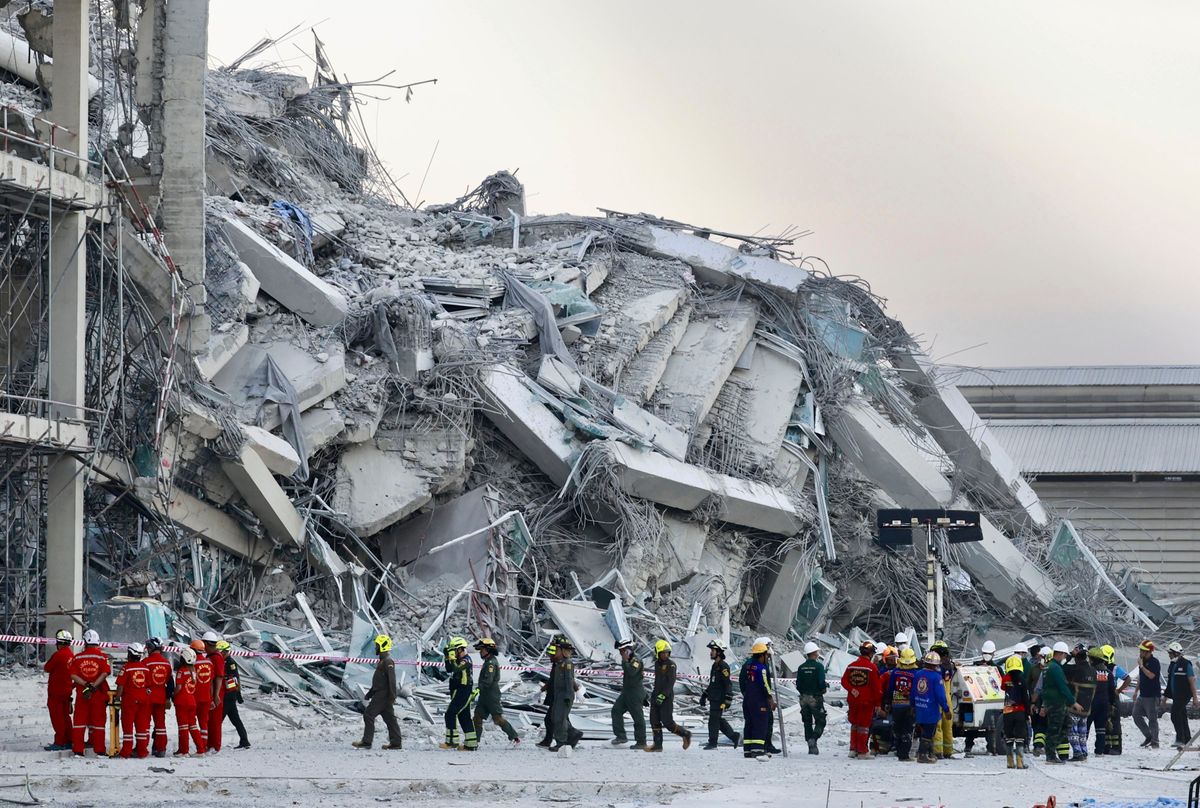
BANGKOK (AP) — A court in Thailand on Wednesday found a Chinese executive and Thai shareholders of a Thai subsidiary of a Chinese state-owned construction company guilty of illegally operating a business in Thailand in a case related to the collapse of a Bangkok office building last year.
At least 92 people died on March 28, 2025, when an earthquake struck the partially built high-rise, which was to house the State Audit Office. It was the only building in Thailand to collapse completely due to the 7.7-magnitude quake, which was centered in neighboring Myanmar.
The tower was being built by a joint venture between China Railway No. 10 (Thailand) and Italian-Thai Development. Executives from both companies are also facing separate proceedings over alleged wrongdoing related to the building’s collapse.
China Railway No. 10 (Thailand) and its director, Zhang Chuanling, were found guilty of violating Thailand’s Foreign Business Act by using Thai nominee shareholders to conceal the company’s foreign ownership and operating a construction business without the required permission. The Criminal Court in Bangkok fined the company and Zhang 1 million baht ($29,450) each and sentenced Zhang to three years in prison, while also ordering the company to cease operations.
The defendants had denied the charges and were granted bail.
China Railway No. 10 (Thailand) is a Thai-registered affiliate of China Railway No. 10 Engineering Group, part of the Chinese state-owned China Railway group, which operates internationally.
The court’s action comes after increasing public concern about Chinese influence over local business, especially through the use of Thai citizens as proxies to disguise their real ownership. In some cases, the concern extends to suspicion that such enterprises are fronts for illegal activities, including money laundering and online scams.
The involvement of Chinese companies in the building collapse and other construction-related accidents has drawn considerable attention. The most notable other accident took place in January this year on a line that is part of a Thai-Chinese high-speed railway project linking the capital to northeastern Thailand. At least 32 people were killed and dozens injured when a construction crane crashed onto a moving passenger train, derailing it.
Italian-Thai Development was also the construction contractor for the railway project, and a Chinese company handled design and construction supervision.
After the train accident, China’s ambassador to Thailand, Zhang Jianwei, said that China requires its companies to follow the rules when participating in overseas projects, and that Beijing is willing to “guide Chinese companies to actively cooperate with the Thai authorities’ investigation.”
Wednesday’s court case also saw three Thai shareholders found guilty of acting as nominees for China Railway No. 10 (Thailand). Two were sentenced to six years in prison each and fined 2 million baht ($58,900), while the third received a three-year prison term and a 1-million-baht ($29,450) fine. However, the court reduced their sentences and their fines by one-fifth after they confessed to the offenses.
By JINTAMAS SAKSORNCHAI
Associated Press