




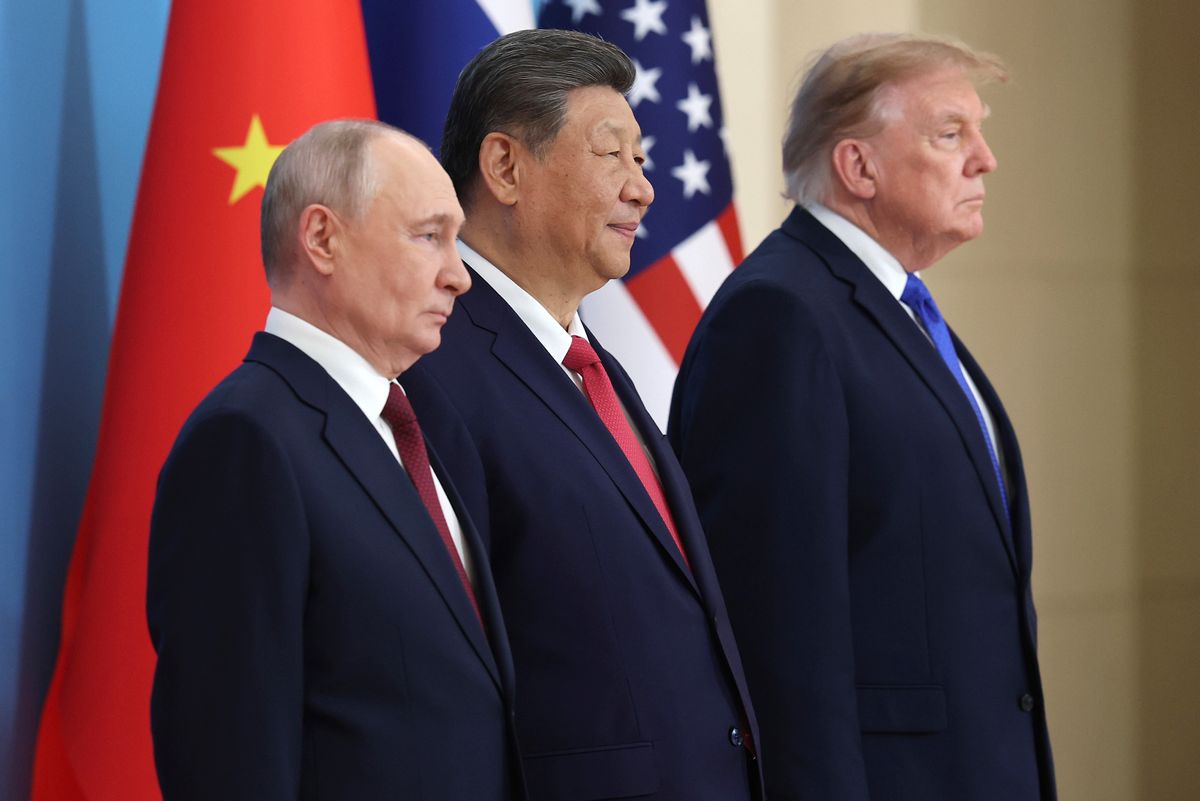
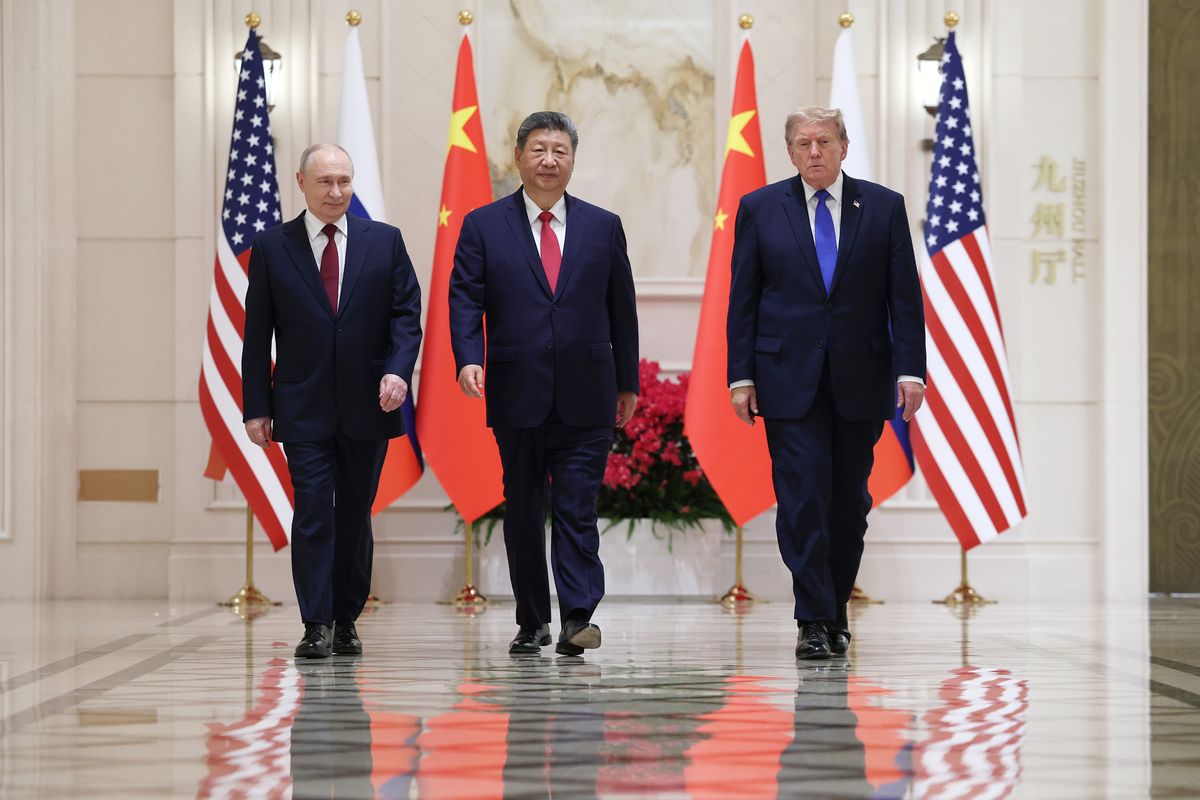
This week’s meeting between Russian President Vladimir Putin, Donald Trump and Xi Jinping, billed as historic, yielded no visible breakthroughs and in the end looked like a fleeting photo op.
But in Russia, state-backed media and commentators ascribed global importance to it, jumping at the chance to paint Putin as the leader of a superpower on a par with the United States and China, and his adversaries in Europe as absent from the conversation about the fate of the world.
A short “peace declaration” released after the talks said the three leaders would like to reform the United Nations, refine more fossil fuels, curb the reach of the International Criminal Court, which had issued an arrest warrant for Putin, and have a dialogue on reducing nuclear risks. Think pieces and commentary in Russia referenced it heavily, and depicted Putin as striving for world peace.
Those depictions contrasted sharply with his deadly full-scale invasion of Ukraine, now in its fifth year. Explosions and sirens rang out across Kyiv on Thursday, and overnight into Friday Putin’s forces pounded multiple regions of Ukraine with missiles and drones, killing and wounding civilians.
Still, Russian state news agency RIA Novosti in an opinion column on Friday morning said that the three leaders met “to save the world,” amid fears of impending nuclear doom, and “to maintain peace at all costs through constant dialogue and mutual compromises.”
Senior lawmaker Konstantin Kosachev on Thursday night said the meeting was about “the responsibility of the three powers for the security of the planet” and described the trilateral gathering in China’s Shenzhen as “a coalition of those wishing peace.”
Fyodor Lukyanov, a Moscow-based foreign policy expert, argued Friday in the state newspaper Rossiyskaya Gazeta that the meeting in China “draws a line under that very world order that dates back to the 1940s,” in which the U.S. dominated and Europe was part of what Russia has dubbed “the collective West.”
In Shenzhen, the U.S. talked to Russia and China on an apparently equal footing, and Europe was “absent” from the conversation, he wrote.
State TV channel Russia 1 in its Friday morning news bulletin also stressed that Europe “wasn’t invited” to the talks, which took place on the sidelines of the Asia Pacific Economic Cooperation summit, a grouping Europe is not a member of.
Dmitry Medvedev, a former Russian president who currently serves as deputy chair of the country’s Security Council and is known for his hawkish anti-Western rhetoric, posted a photo on X on Friday, showing Putin, Xi and Trump seated around the table in Shenzhen. “Hm, where’s Europe?” Medvedev wrote in English.
The actions of both the Russian and the U.S. leaders in the meantime suggested that Europe was not as irrelevant as Russian state media and officials suggested.
Ukraine’s European allies met with U.S. envoys in Berlin on Thursday to explore Ukraine’s postwar security arrangements. Trump called into the meeting after his talks with Putin, according to his envoy and son-in-law Jared Kushner.
Putin on Thursday revealed that the Kremlin has invited European officials to Moscow for talks — a proposition that Germany has signaled skepticism about.
The Russian president’s stated willingness to engage in a peace effort, however, came into question the next day, when a Russian missile came down in Poland. Polish Prime Minister Donald Tusk said it was likely a deliberate provocation coinciding with European military exercises in the country, part of preparations for a potential postwar mission in Ukraine.
European Council President António Costa expressed solidarity with Poland, saying that the incident demonstrates that “unfortunately, Russia instead of (showing) willingness to engage in peace talks continues to spread their threats.”
———
Associated Press writer Lorne Cook in Brussels contributed.
By DASHA LITVINOVA
Associated Press