




Secretary of State Marco Rubio suggested Sunday that the U.S. would not take a day-to-day role in governing Venezuela, a turnaround after President Donald Trump announced a day earlier that the U.S. would be running Venezuela following its ouster of leader Nicolás Maduro.
Rubio’s statements seemed designed to temper concerns about whether the assertive American action to achieve regime change might again produce a prolonged foreign intervention or failed attempt at nation-building. They stood in contrast to Trump’s broad but vague claims that the U.S. would at least temporarily “run” the oil-rich nation.
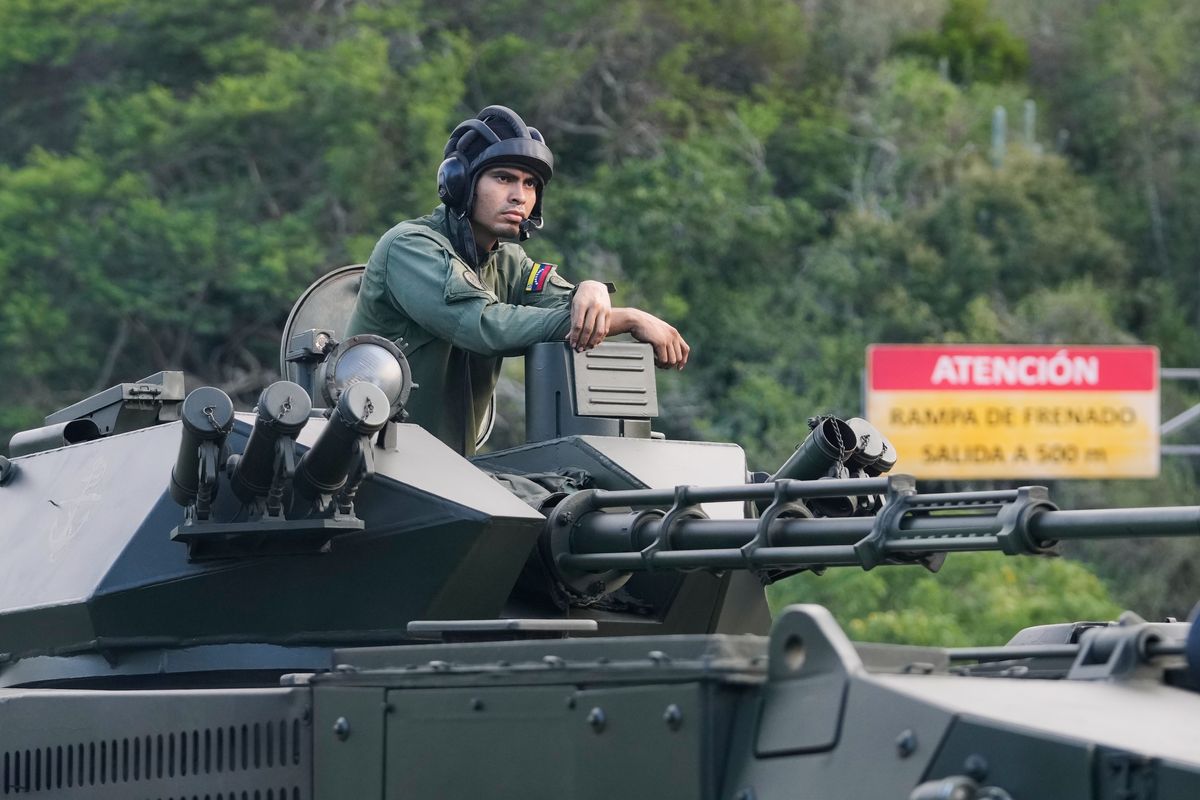
Venezuela’s defense minister demanded Maduro’s release, maintaining that he is still the rightful leader of the South American country. The military, which has long acted as the arbiter of political disputes in Venezuela, has thrown its support behind Delcy Rodríguez, who served as vice president under Maduro.
Meanwhile, a tense calm hangs over Venezuela after the U.S. military operation that deposed Maduro, who was brought to New York to face criminal charges.
Maduro and his wife landed late Saturday afternoon at a small airport in New York. The couple face U.S. charges of participating in a narco-terrorism conspiracy. Their first court appearance is set for Monday.
Here’s the latest:
Cuba says 32 Cuban security officers were killed in the US attack on Venezuela
A statement read on Cuban state TV Sunday night announced the deaths of the Cuban military and police officers.
It was the first official death count announced by any authority following the American strikes.
What the Cubans were working on in the South American nation was unclear, but Cuba is a close ally of Venezuela’s government and has sent military and police forces to assist in operations for years.
Cuba’s government announced two days of mourning because of the deaths.
Before the Cuban announcement, Trump told reporters aboard Air Force One: “You know, a lot of Cubans were killed yesterday.”
“There was a lot of death on the other side. No death on our side,” Trump said.
Secretary of State Rubio said earlier Sunday on NBC that Cuban officers “are the ones that were propping up Maduro. His entire, like, internal security force, his internal security apparatus is entirely controlled by Cubans.”
Trump suggests US military action could be coming in Colombia and Mexico but says Cuba may simply fall on its own
In his comments aboard Air Force One, Trump said Venezuela was sick and needed U.S. support, adding, “Colombia’s very sick too. Run by a sick man who likes making cocaine and selling it to the United States. And he’s not going to be doing it very long.”
Asked if that might mean a U.S. operation that could target Colombia President Gustavo Petro, Trump responded, “Sounds good to me.”
He later said, “You have to do something with Mexico. Mexico has to get their act together,” and better combat drug trafficking.
Trump said he’d repeatedly offered U.S. troops to Mexico but that country’s president, Claudia Sheinbaum, is “concerned, she’s a little afraid.”
Questioned about U.S. military force in Cuba, however, Trump said, “I think it’s just going to fall.”
“I don’t think we need any action,” the president said.
Trump says ‘a lot of Cubans were killed’ in Venezuela
Trump told reporters aboard Air Force One that “a lot of Cubans were killed” during the intervention to capture Maduro.
He didn’t specify how many Cubans were killed but said “there was a lot of death on the other side.”
Asked whether he was considering taking military action against Cuba, Trump said the country is “going down for the count.”
The U.S. has said Cuba, a close ally of Maduro’s administration, provided security advisers to Venezuela’s government.
Trump calls on Venezuela’s VP to provide ‘total access’
Speaking to reporters on Air Force One, Trump said he wanted Venezuela’s vice president, Delcy Rodríguez, to provide “total access” to the country.
Trump threatened that Rodriguez “will face a situation probably worse than Maduro” if she doesn’t cooperate with the U.S.
Trump told The Atlantic earlier Sunday that Rodríguez could “pay a very big price” if she doesn’t do what he thinks is right for Venezuela. On Saturday, Trump said Secretary of State Marco Rubio had spoken with her and that she was willing to do what the U.S. thinks is needed.
Rodríguez has criticized Maduro’s removal from the country and has demanded that the U.S. return him.
After Venezuela, what’s next?
Comments from Trump and Rubio underscore that the U.S. administration is serious about taking a more expansive role in the Western Hemisphere.
A day after the military operation in Venezuela, Trump renewed his calls for a U.S. takeover of the Danish territory of Greenland for the sake of U.S. security interests, while his secretary of state declared the communist government in Cuba is “in a lot of trouble.”
Trump has also pointed to the 19th century Monroe Doctrine, which rejects European colonialism, as well as the Roosevelt Corollary — a justification invoked by the U.S. in supporting Panama’s secession from Colombia, which helped secure the Panama Canal Zone for the U.S. — as he’s made his case for an assertive approach to American neighbors and beyond.
Trump is rattling hemispheric friends and foes alike, spurring a pointed question around the globe: Who’s next?
▶Read more about Trump’s potential plans for Greenland and Cuba
Venezuelan opposition leader calls on government to withdraw support of Maduro
Edmundo González, who is widely believed to have won the country’s 2024 elections, called on Venezuela’s military in a video statement on Sunday night to withdraw its support of Maduro.
González said that Venezuela was at an “inflection point” that could pave the path to democracy.
“The person who usurped power (Maduro) is no longer in the country and is facing justice,” he said. “This shapes a new political scenario.”
González did not go as far as to insist that he be named president, but requested that the government recognize the results of the 2024 elections. It wasn’t clear if he wanted Delcy Rodríguez, the next in line in Maduro’s chain of succession, to step down.
Trump’s plan to seize and revitalize Venezuela’s oil industry faces major hurdles
The president’s plan to take control of the oil sector and have U.S. companies revitalize it also isn’t likely to have a significant immediate impact on oil prices.
Venezuela’s oil industry is in disrepair after years of neglect and international sanctions, so it could take years and major investments before production can increase dramatically.
Some analysts are optimistic that Venezuela could double or triple its current output of about 1.1 million barrels of oil a day to return to historic levels fairly quickly. But American oil companies will want a stable regime in place before they are willing to invest heavily.
Venezuela has the world’s largest proven crude oil reserves, according to the U.S. Energy Information Administration.
▶Read more about Trump’s plan and Venezuela’s oil industry
Who is Delcy Rodríguez, Venezuela’s surprise interim leader?
Rodríguez, a 56-year-old lawyer and politician, served as Maduro’s vice president since 2018, overseeing much of Venezuela’s oil-dependent economy and its feared intelligence service.
She was next in the presidential line of succession. She’s also part of a band of senior officials in Maduro’s administration that now appears to control Venezuela, even as Trump and other U.S. officials say they will pressure the government to fall in line with their vision for the oil-rich nation.
Venezuela’s high court ordered Rodriguez to assume the role of interim president on Saturday, and she was backed by Venezuela’s military.
In a televised address, Rodríguez gave no indication that she would cooperate with Trump, referring to his government as “extremists.”
▶Read more about Delcy Rodríguez, Venezuela’s interim president and Maduro ally
Venezuelans in Philadelphia gather at Mass to reflect amid hope
Members of the city’s Venezuelan community gathered at the Cathedral Basilica of Saints Peter and Paul to pray for their home country and share thoughts about the weekend’s events.
About 100 people attended the Spanish-language service, with some holding Venezuelan flags.
Andrea Abati, a Venezuelan college student, said some of her fellow citizens are pleased to see Maduro’s removal, but at the same time they are uncertain about what comes next.
“It’s a mix of feelings between happiness, because finally it was happening what we wanted to happen in a way, and at the same time just thinking what’s next,” she said. “I think for everyone it was very shocking at the beginning and it’s still shocking. I think we are still all processing what’s going on.”
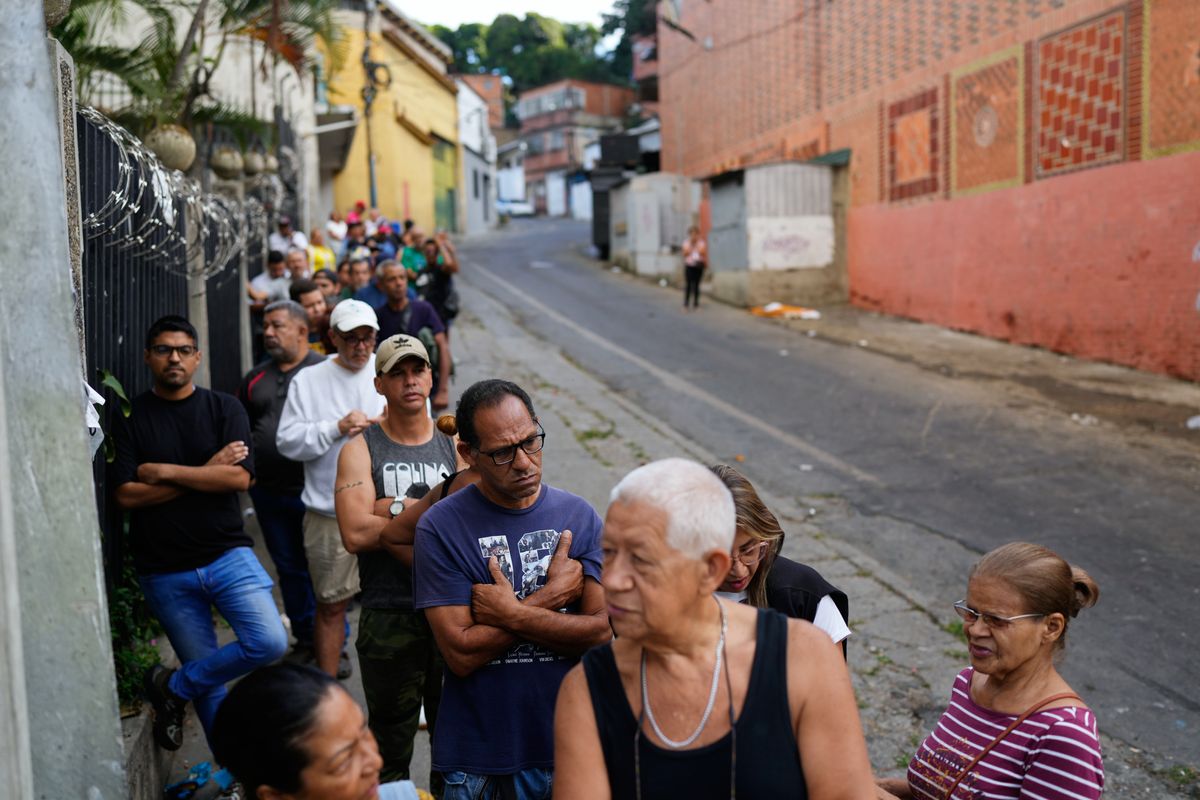
Anxiety and trepidation in a quiet Caracas
People were slow to resume routines in Caracas after Maduro’s capture. Dozens of stores, restaurants and churches remained closed. Those on the streets looked shell-shocked, staring at their phones or into the distance.
State-controlled media did not air the images of Maduro handcuffed on U.S. soil. Venezuelans instead saw them on social media, and many could not believe their eyes.
“May God give us strength for what we are experiencing. I’m sad. He is a human being,” said Nely Gutiérrez, a retiree, as her eyes welled with tears. “They have him handcuffed, and if he is in the hands of the empire, no one can save him from there, only God, not even God. He will die there.”
Gutiérrez had walked to church only to find it closed. She said she would have prayed for peace in Venezuela and for Maduro. She declined to say whether she ever voted for him but said, “The word of God says love your enemy.”
▶Read more about the scene in Caracas here.
US indictment alleges Maduro ran ‘corrupt, illegitimate government’ fueled by cocaine
A newly unsealed U.S. Justice Department indictment contends Maduro’s government was fueled by an extensive drug-trafficking operation that flooded the U.S. with thousands of tons of cocaine.
Maduro is charged alongside his wife, Cilia Flores,who was also arrested on Saturday. Also indicted are his son and three others.
U.S. authorities allege that Maduro and his family “provided law enforcement cover and logistical support” to cartels moving drugs throughout the region, resulting in as much as 250 tons of cocaine trafficked through Venezuela annually by 2020, according to the indictment.
Maduro is indicted on four counts: narco-terrorism conspiracy, cocaine importation conspiracy, possession of machine guns and destructive devices and conspiracy to possess machine guns and destructive devices.
Maduro faces the same charges as in an earlier indictment brought against him in Manhattan federal court in 2020, during the first Trump presidency. The new indictment unsealed Saturday, which adds charges against Flores, was filed under seal in the Southern District of New York just before Christmas.
▶Read more about the indictment
In court, Maduro will likely follow the path taken by Panama’s Manuel Noriega
Maduro was captured 36 years to the day after Noriega was removed by American forces. And as was the case with the Panamanian leader, lawyers for Maduro are expected to contest the legality of his arrest, arguing that he is immune from prosecution as a sovereign head of a foreign state, which is a bedrock principle of international and U.S. law.
It’s an argument that is unlikely to succeed and was largely settled as a matter of law in Noriega’s trial, legal experts say.
Although Trump’s ordering of the operation in Venezuela raises constitutional concerns because it wasn’t authorized by Congress, now that Maduro is in the U.S., courts will likely bless his prosecution because, like Noriega, the U.S. doesn’t recognize him as Venezuela’s legitimate leader.
▶Read more about how Maduro’s case will revive a legal debate over immunity for foreign leaders
No change in U.S. warships in the region
A U.S. Navy official says no major changes in the service’s forces in the region — either additions or withdrawals — have been made since the operation in Venezuela.
The Navy has at least 11 warships in the area, including the aircraft carrier USS Gerald R. Ford. The official spoke on condition of anonymity to discuss sensitive military operations.
Secretary of State Marco Rubio told NBC’s “Meet the Press” that the Trump administration planned to keep targeting boats accused of trafficking drugs as well as sanctioned oil tankers.
Rubio said no U.S. forces were on the ground in Venezuela but didn’t rule out further strikes on the country.
— By Konstantin Toropin
‘This is it, what we are left with: ruins.’
In Venezuela’s coastal state of La Guaira, families with houses damaged in blasts during the U.S. operation were cleaning up debris.
Wilman González, who was left with a black eye from a blast, picked through rubble on his floors, surrounded by broken furniture. One part of his apartment building was almost entirely blown off, leaving walls gaping.
A number of people were killed by the U.S. strikes, though Venezuelan officials did not confirm how many. Among those killed was González’s aunt.
“This is it, what we are left with: ruins,” he said.
Delcy assumes role of interim president but what happens next is uncertain
On Saturday, Venezuela’s high court ordered Vice President Delcy Rodriguez to assume the role of interim president.
Venezuela’s constitution requires elections must be held within 30 days if a president becomes “permanently unavailable,” but the nation’s loyalist Supreme Court declared Maduro’s absence “temporary,” a scenario where there is no immediate election requirement.
Instead, the vice president, an unelected position, takes over for up to 90 days — a period that can be extended to six months with a vote of the National Assembly.
In handing temporary power to Rodriguez, the Supreme Court made no mention of the 180-day time limit, leading some to speculate she could try to remain in power even longer as she seeks to unite the disparate factions of the ruling socialist party while shielding it from what would certainly be a stiff electoral challenge.
Concern in Cuba after Venezuela operation
Concern simmered in Cuba, one of Venezuela’s most important allies and trading partners, a day after the Trump administration warned it could turn its attention to the Caribbean nation.
“If I lived in Havana and I was in the government I’d be concerned, at least,” Secretary of State Marco Rubio said on Saturday.
Cuban authorities railed against the U.S. military operation, writing in a statement: “All the nations of the region must remain alert, because the threat hangs over all of us.”
On Sunday, Cubans like 55-year-old biochemical laboratory worker Bárbara Rodríguez was among many following developments in Venezuela and worried about what she described as an “aggression against a sovereign state.”
“It can happen in any country, it can happen right here. We have always been in the crosshairs (of the United States),” she said.
More U.S. airlines offer additional flights to and from the Caribbean
Carriers including American, United, Delta and JetBlue say they have added extra flights on top of resuming their scheduled services in the eastern Caribbean after many flights in the region were canceled by the U.S. military action in Venezuela.
American Airlines says it is offering more than two dozen additional flights on Sunday and Monday, including round-trip flights to Antigua, Curacao and Puerto Rico. United Airlines has added at least 14 flights, while Delta Air Lines says it’s adding three additional flights Sunday.
Southwest Airlines announced Saturday that it added more round-trip Puerto Rico flights to its Sunday and Monday schedules, as well as round-trip flights to Aruba on Sunday.
Venezuela’s military leader demands Maduro’s release
Venezuela’s defense minister demanded the release of Maduro, maintaining that he is still the rightful leader of the South American country.
Venezuela’s armed forces “categorically reject the cowardly kidnapping” of Maduro, said General-in-Chief Vladimir Padrino López, flanked by the high military command during a nationwide radio and television broadcast.
Padrino López — without mentioning a death toll — said the capture occurred after “cold-bloodedly murdering a large part of his security team, soldiers, soldiers and innocent civilians.”
The military, which has long acted as the arbiter of political disputes in Venezuela, has thrown its support behind Rodríguez.
Danish ambassador says government expects US to respect territorial integrity of Greenland
The envoy to the U.S. made the statement after Katie Miller, wife of White House senior adviser Stephen Miller, posted on X a map of Greenland colored in stars and stripes and with the written note “SOON”.
“We do need Greenland, absolutely,” Trump himself told The Atlantic in an interview on Sunday.
“Just a friendly reminder about the US and the Kingdom of Denmark,” Ambassador Jesper Møller Sørensen wrote in his post on X responding to Miller. “We are close allies and should continue to work together as such. US security is also Greenland’s and Denmark’s security. Greenland is already part of NATO.”
Trump called repeatedly for U.S. jurisdiction over Greenland during his presidential transition and in the early months of his second term.
Greenland possesses natural resources that include oil, gas, and rare earth elements. Denmark is responsible for the autonomous territory’s foreign affairs and defense.
Venezuelan immigrants in the US likely won’t get back deportation protections after Maduro’s capture
Last year, the Trump administration removed Temporary Protected Status for some 600,000 Venezuelan immigrants in the U.S. which had allowed them to work and stay in the country for a period.
When asked whether TPS would be reinstated for Venezuelans on Fox News Sunday, Homeland Security Secretary Kristi Noem defended the decision to revoke it.
Without TPS, those Venezuelans can be deported back to their home country, which is now reeling from the military operation and Maduro’s capture.
Noem said those who had TPS would be able to apply for refugee status.
Trump says Venezuela’s vice president could face a fate worse than Maduro if she doesn’t go along with US
Trump told The Atlantic on Sunday in a telephone interview that Delcy Rodríguez, Venezuela’s vice president, could “pay a very big price” if she doesn’t do what he thinks is right for the South American country.
That contrasted with the Republican president’s comments about Rodríguez on Saturday when he said Secretary of State Marco Rubio had spoken with her and that she was willing to do what the U.S. thinks is needed to improve the standard of living in Venezuela.
But Rodríguez has criticized Maduro’s removal from the country and has demanded that the U.S. return him.
Trump told the magazine that “if she doesn’t do what’s right, she is going to pay a very big price, probably bigger than Maduro.” The president told the New York Post in an interview Saturday that the U.S. wouldn’t need to station troops in Venezuela if she “does what we want.”
Iran warns the US against military action
Associated Press video on Sunday shows a banner now on display in Iran’s capital warning the United States and Israel that their soldiers could be killed if they take action in the country.
Trump’s recent comment that the U.S. “will come to their rescue” if Iran kills peaceful protesters has taken on a new meaning after the U.S. capture of Venezuelan President Nicolás Maduro, a longtime ally of Tehran.
Iran’s Foreign Ministry has condemned the “illegal U.S. attack against Venezuela.” U.S. Defense Secretary Pete Hegseth has said adversaries of the U.S. should note that “America can project our will anywhere, anytime.”
Protests against Trump’s plans in Venezuela pop up across the US
From California to Missouri and Texas, protesters are planning demonstrations Sunday and through the week against President Donald Trump’s military operation and capture of Maduro, which one protest description called “the illegal, unconstitutional invasion of Venezuela.”
Dozens appear to be organized by chapters of Indivisible, a left-leaning group, and many take umbrage with Trump’s plans to take control of Venezuela’s oil industry and ask American companies to revitalize it.
What congressional leaders and governors say about the Venezuela operation
U.S. Sen. Chuck Grassley, a Republican from Iowa who serves as Senate president pro tempore, posted on X Saturday that Maduro is a narco-terrorist and his drug trafficking resulted in the deaths of too many Americans. He likened the Trump operation to then-President George Bush’s decision in 1989 to capture Panamanian dictator Manuel Noriega following his indictment for drug trafficking.
Illinois Gov. JB Pritzker, a Democrat and one of President Donald Trump’s most outspoken critics, posted that U.S. military action in Venezuela is unconstitutional and is putting troops in harm’s way with no long-term strategy. “The American people deserve a President focused on making their lives more affordable,” Pritzker wrote.
U.S. Sen. Tammy Baldwin, a Democrat from Wisconsin, posted a statement on X calling the strikes illegal and criticizing Trump for taking action without congressional approval. “The President does not have the unilateral authority to invade foreign countries, oust their governments, and seize their resources,” she wrote.
Trump wants the Venezuelan VP to lead or get out of the way, Noem says
Homeland Security Secretary Kristi Noem says President Donald Trump’s conversations with Venezuelan Vice President Delcy Rodriguez now are ”very matter-of-fact and very clear: You can lead or you can get out of the way, because we’re not going to allow you to continue to subvert American influence and our need to have a free country like Venezuela to work with rather than to have dictators in place who perpetuate crimes and drug trafficking.”
Rubio says US will use control of Venezuela’s oil to influence policy
Secretary of State Marco Rubio appeared to back off Trump’s assertions that the U.S. was running Venezuela, insisting instead that Washington will use control of the South American country’s oil industry to force policy changes and, “We expect that it’s going to lead to results here.”
“We’re hopeful, hopeful, that it does positive results for the people for Venezuela,” Rubio told ABC’s “This Week.” “But, ultimately, most importantly, in the national interest of the United States.”
Asked about Trump suggesting that Rubio would be among the U.S. officials helping to run Venezuela, Rubio offered no details but said, “I’m obviously very intricately involved in the policy” going forward.
He said of Venezuela’s interim leader: “We don’t believe this regime in place is legitimate” because the country never held free and fair elections.
A tense calm prevails on mostly empty streets of Caracas
Venezuela’s capital Caracas was unusually quiet Sunday with few vehicles moving around. Convenience stores, gas stations and other businesses were mostly closed.
The presence of police and members of the military across the city was notable for its smaller size compared with an average day and even more so with the days when people protested against Maduro’s government in previous years.
Meanwhile, soldiers attempted to clear an area of an air base that had been on fire along with at least three passenger buses following Saturday’s U.S. attack.
After capture and removal, Venezuela’s Maduro is being held at notorious Brooklyn jail
The Brooklyn jail holding Nicolás Maduro is a facility so troubled that some judges have refused to send people there even as it has housed such famous inmates as music stars R. Kelly and Sean “Diddy” Combs.
Opened in the early 1990s, the Metropolitan Detention Center, or MDC Brooklyn, currently houses about 1,300 inmates.
It’s the routine landing spot for people awaiting trial in federal courts in Manhattan and Brooklyn, holding alleged gangsters and drug traffickers alongside some people accused of white collar crimes.
Maduro is not the first president of a country to be locked up there.
Juan Orlando Hernández, the former president of Honduras, was imprisoned at MDC Brooklyn while he was on trial for trafficking hundreds of tons of cocaine into the U.S. Hernández was pardoned and freed by President Donald Trump in December.
▶ Read more about MDC Brooklyn
By The Associated Press