




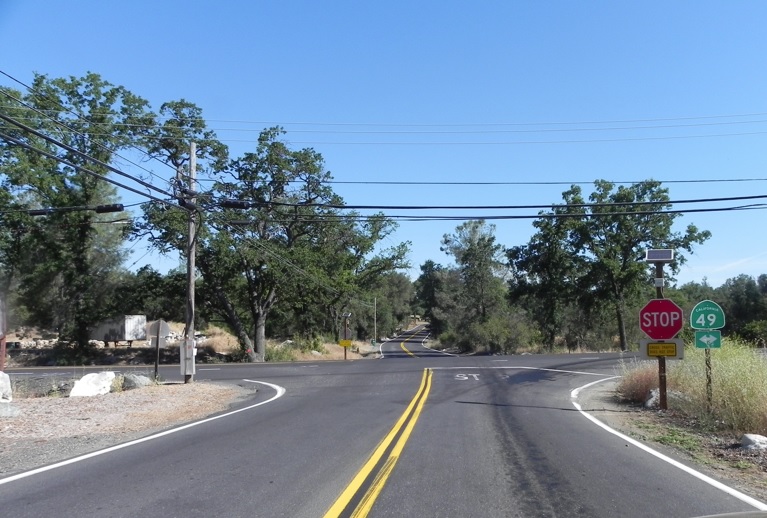
Sonora, CA — A four-way stop to be installed next month at the Highway 49 and Shaws Flat Road intersection is designed as a short-term safety fix while a longer-term solution is investigated.
We reported earlier that some of the Tuolumne County Board of Supervisors voiced pointed concerns about the plan at Tuesday’s meeting.
Caltrans spokesperson Erin McQueary relays to Central Sierra Broadcasting that the intersection was identified as a dangerous “hot-spot” during a routine statewide screening. In response, the regional Caltrans District 10 traffic safety team did an engineering investigation. It determined that an “all-way stop with flashing beacons” is the best immediate measure to improve safety. Long-term, however, Caltrans is developing a report to evaluate other alternatives.
McQueary adds that the timeline for any bigger, future project will depend on the selected final alternative and funding availability (at Tuesday’s Supervisors meeting, it was alluded to that it could be anything ranging from a roundabout to a traffic light).
The short-term fix will include installing “stop ahead” warning signs with pavement markings on the north and south approaches, new stop signs with “all-way” plaques, and flashing beacons to warn incoming traffic.
McQueary states, “The goal of these improvements is to reduce both the frequency and severity of angle‑type crashes, including broadside crashes. Research shows that converting a two‑way stop to an all‑way stop with flashing beacons can reduce total crashes by approximately 82 percent and fatal or injury crashes by approximately 87 percent.”
Caltrans also considered leaving just the two current stops and installing flashing beacons as a standalone option (for north and south travelers). However, McQueary says, “While flashing beacons can enhance driver awareness and reduce certain crash types at stop‑controlled intersections, we did not identify evidence showing safety benefits comparable to those achieved through an all‑way stop at rural intersections with documented angle‑crash patterns.”
Caltrans officials argue that the project is based on several years of collision data and a detailed engineering analysis to determine the “most appropriate, research‑supported solution.”
The agency adds that there will be a public announcement in coordination with other local safety partners once the construction date is finalized (anticipated to be the end of July). Portable changeable message signs will also be set up to advise travelers of the upcoming changes several weeks in advance of the installation.