




Sonora, CA—The California Department of Fish and Wildlife (CDFW) recently completed helicopter capture operations resulting in the satellite collaring of five gray wolves in northern California to reduce the risk of wolf-livestock conflict.
The captures occurred between Jan. 12 and 20 in Lassen, Modoc, Shasta, Siskiyou, and Tehama counties. They are part of the Whaleback and Harvey packs. Immediately after capture, each wolf was flown to a nearby field processing site and fitted with a satellite/VHF collar.
Additionally, CDFW staff collected standard biological data, including body measurements, DNA, and blood samples. The data allow CDFW to monitor wolf health, screen for disease, and assess genetic relatedness among individuals and packs. After collaring, each wolf was released as close to where it was captured as possible.
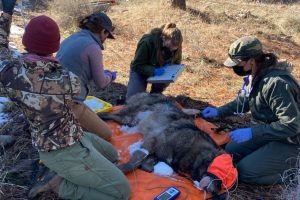
CDFW provided this list of the collared wolves:
- An adult male captured in northern Lassen County was born into the Whaleback pack. Following the release, collar data showed that the wolf returned to its natal Whaleback pack.
- A previously collared, dispersing adult male from the Harvey pack was captured in Modoc County. Its collar was replaced.
- A Harvey pack female born in 2024 and captured in northwestern Lassen County.
- Two Harvey pack females born in 2025 and captured in northwestern Shasta County.
- Wildlife capture operations inherently carry risk to captured animals. During this operation, a sixth wolf—an adult female from the Harvey pack—died after capture. Factors contributing to its death are being investigated.
Over the past decade, CDFW has successfully captured 38 gray wolves statewide to collar them. Currently, 13 wolves are wearing active collars. Within days of capture, the approximate locations of the newly collared wolves began showing on CDFW’s Wolf Tracker mapping tool.
State wildlife officials advise that satellite collaring is an essential tool for wildlife management to monitor wolf populations and analyze their landscape use and movement patterns, which is crucial in reducing wolf-livestock conflicts. These collars do not communicate real-time information to CDFW; instead, they collect numerous position points each day and send this data to CDFW daily. Designed with a battery life of two to three years, each collar is programmed to detach from the animal before the battery is fully drained. For more information on California’s wolves, click here.