




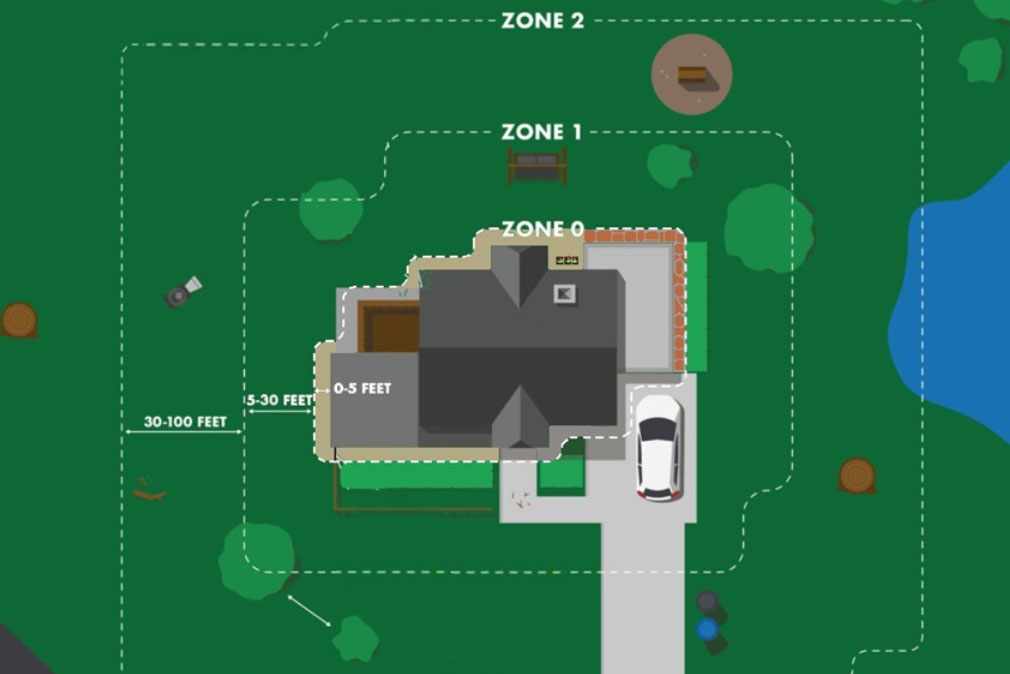
Outstretch your arms and walk the perimeter of your house. That is 5 feet. On Wednesday, August 19, the California Board of Forestry and Fire Protection voted unanimously to approve new landscaping requirements for this area, dubbed Zone Zero. Discussions grew from the devastating 2017 fire season; 2025 LA fires forced the issue.
CAL Fire’s hardscape-first preference applies to homes in State Responsibility Areas and Very High Fire Hazard Severity Zones. Most of our foothill communities lie in State Responsibility Areas, which means that our first line of fire protection is CAL Fire.
Because these regulations are so sweeping, covering everything from postage stamp lots to remote acreages, flexibility was built into the hardscape-first approach. Implementation will take place over a five-year period, prioritizing education and outreach.
Essentially, Zone 0 is everything within 5 feet of a house, including attached structures, stairs, decks, porches, and pergolas. No vegetation is allowed within 12 inches of walls or the eave line. This clearance expands to 24 inches around windows, doors and vents and 5 feet for decks and similar structures.
Any hardscaping with pavers, gravel, decomposed granite and stone is excellent in Zone 0. Removing dry and dead plants is also a good starting point. Bare dirt is perfectly fine, too, although that may be tough for a gardener’s soul.
Hardscaping can be interspersed with potted plants in moveable, noncombustible containers, no bigger than five gallons. Nonwoody, short plants are welcome. Woody and oily plants, such as rosemary and lavender should be moved much farther from the house.
So, what can we plant? Lush green, mown lawns are a water intensive choice for Zone 0. Alternatives are low growing, nonwoody groundcovers like sedums. Plants from 3 to 18 inches tall, such as bulbs, non-thatching succulents, and non woody plants may live in islands around the house. Large trees are exempt although limbs should be far from chimneys, roofs and the ground.
Imagine your house as a rocky outcropping. Surrounding the outcropping are stones of various sizes, decomposed granite and small plants grabbing a foothold in barren soil. These small plants and grasses are tucked formally or informally around the perimeter. Farther from the rock, larger plants take root in richer soil and sunnier spots. Sparse, but not barren.
Contained within 12×12 inch plots, a mixed herb garden grows. Parsley, chives, basil, and chamomile easily fit the short, non woody definition. Natives like miniature lupine, the smaller tufted poppies, Sierra onion, cream cups, blue-eyed grass, shooting star, Sierra stonecrop, red maids, desert dandelion, sea thrift and bird’s eyes gilia all are shorties, with most being drought tolerant to boot. Non-native sedums, germaniums, phlox, speedwell, dwarf mints, society garlic, dianthus, low growing succulents, summer dormant bulbs and a variety of fescues, some native, also thrive in a dry, Zone 0 region.
Many plants can find new homes outside Zone 0. Choose a site where your plants will be happy. Wait until the cool, dormant season, then get digging. Keeping as much of the root ball intact as possible, place the plant in a hole no deeper than the root ball. Tuck it in with some groundcover and give it a regular, deep watering until it gets established again. With an intense El Niño spreading across the Pacific, we may be getting some wet weather this winter, perfect for getting these plants reestablished and happy again.
Find your Fire Hazard Severity Zone on the Office of the State Fire Marshal’s website:
Selena Carrick is a University of California Cooperative Extension Master Gardener of Calaveras County.