




Sonora, CA — The US Census Bureau released a nationwide report that lists Tuolumne County on one of its top 10 lists.
Nationwide, population growth was 1% in the US between 2023 and 2024 and fell to 0.5% from 2024 to 2025. Factors cited by the US Census Bureau in the report included lower levels of international migration and some areas having more deaths than births.
It also highlighted which counties in the US grew the most, and which had the steepest declines.
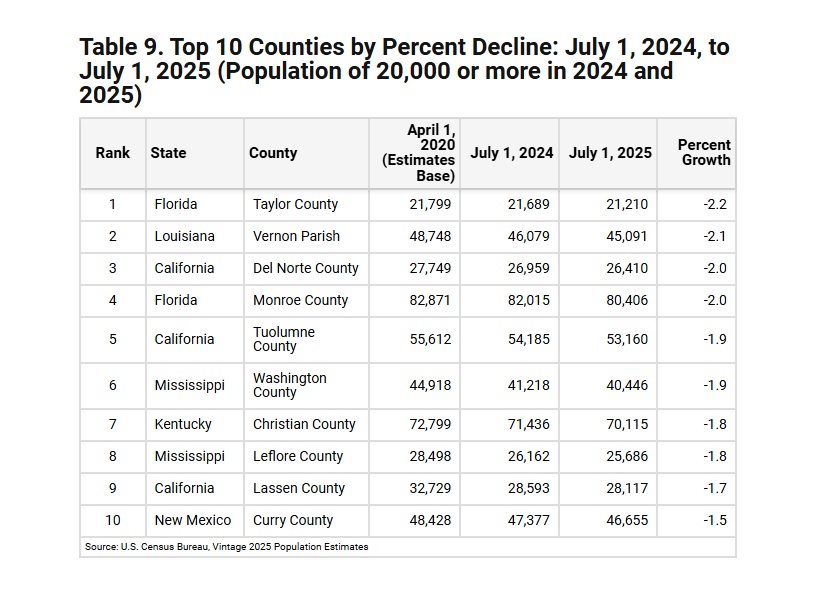
Tuolumne County ranked 5th in seeing the largest percentage decline. Its population went from 54,185 in 2024 to 53,160 in 2025 (1.9% decline).
The top five decliners were Taylor County, Florida (-2.2%), Vernon Parish, Louisiana (-2.1%), Del Norte County, California (-2%), Monroe County, Florida (-2%), and Tuolumne County (-1.9%).
The top five gainers by percentage were Jasper County, South Carolina (6%), Waller County, Texas (5.7%), Kaufman County, Texas (5.7%), Jackson County, Georgia (5.3%), and Long County, Georgia (5.2%).
Other neighboring Mother Lode counties saw either growth or declines of less than a percent. Calaveras grew by 0.2% over the past year (from 46,496 to 46,605), Amador County declined by 0.2% (41,974 to 41,876), and Mariposa County fell by 0.18% (16948 to 16,918).
The Census Bureau noted “Key Takeaways” in the national report:
- Geographically, many of the fastest-growing counties were in states along the southeast coast of the United States in Florida, Georgia, South Carolina, North Carolina, and Virginia.
- Among some of the largest metro areas, the fastest-growing counties tended to be on the outer edges, a pattern especially pronounced in Texas.
- Among counties with populations of 20,000 or more, nine of the top 10 fastest-growing counties were in the South, as were 45 out of the top 50.
- Growth declined dramatically in metro areas — on average from 1.1% between 2023 and 2024 to 0.6% between 2024 and 2025.
It also notes that 2,066 of the 3,143 counties across the country saw a population increase between July of 2024 and July of 2025. However, 80% of those counties referenced grew at a lower statistical pace than the previous period.