




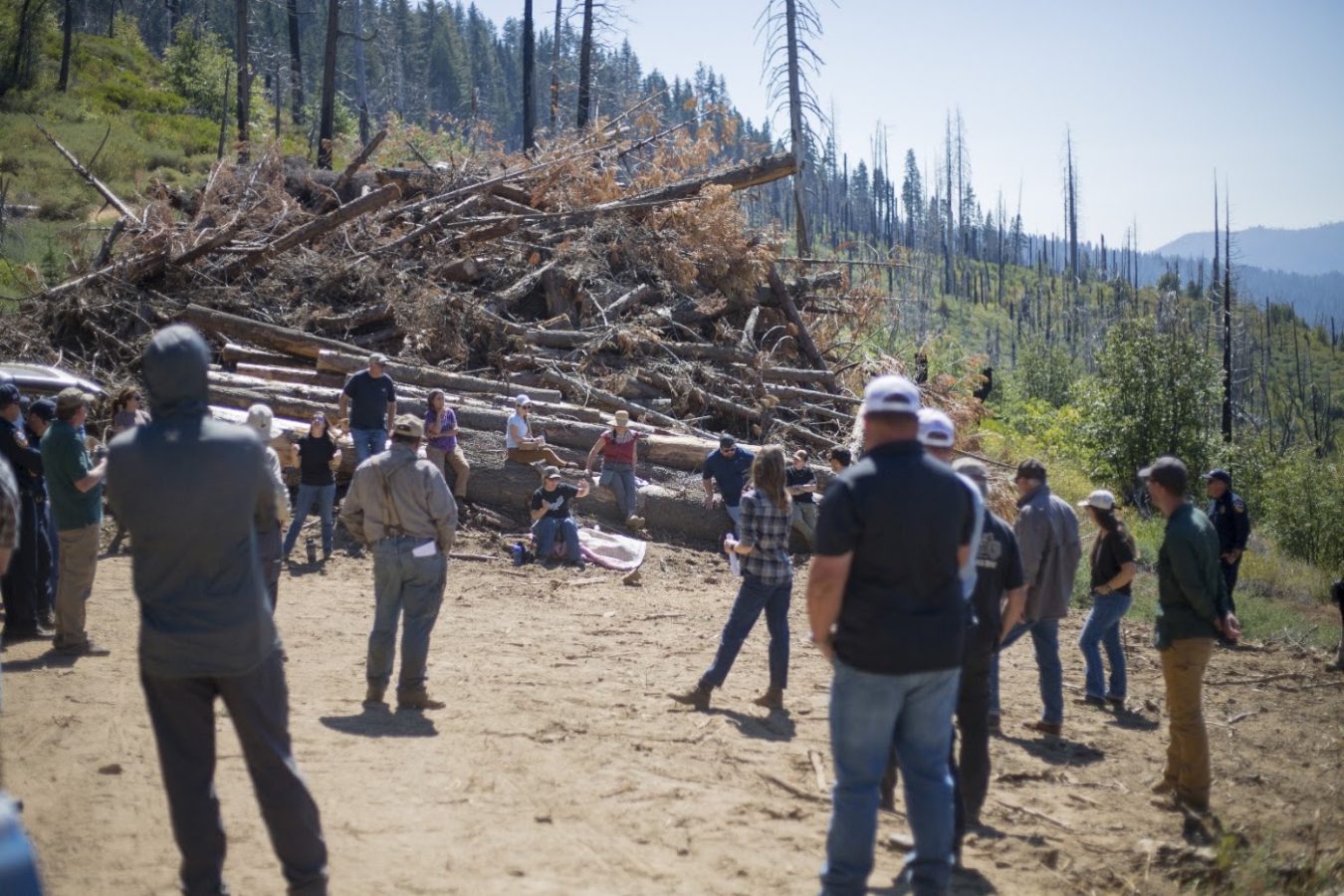
A day-long Tuolumne County tour provided Board of Forestry and Fire Protection members and community participants with an on-the-ground look at what California’s working forest economy.
The Board of Forestry and Fire Protection is California’s statutory authority for state and federal issues related to forestry and fire protection policy. Their projects include the Fire Hazard Severity map and Defensible Space Zone regulations. The tour in Tuolumne County was a collaboration of Mother Lode Job Training (MLJT), the Central Sierra Economic Development District (CSEDD), the California Board of Forestry and Fire Protection, CAL FIRE, Yosemite Rivers Alliance, BurnBot, Mutzner Trucking, Tuolumne BioEnergy, the Stanislaus National Forest, and many regional partners.
The tour visited a Sierra Village CAL Fire site where beneficial fire effects, cone collection and forest restoration work were talked about. Presentations were provided by Marisa Salazar and members of the Tuolumne-Calaveras Unit Resource Management Team, alongside Kevin Bohall, Bill Barteau, and Roger Petersen.
Next, near Long Barn, there was a presentation led by Alex Gorman of the Yosemite Rivers Alliance and a BurnBot fuel reduction demonstration. The BurnBot is a remote controlled masticator the size of a golf cart with two continuous tracks on either side that can handle steep terrain. Nick Lombardo, Senior Director of Forestry Programs with BurnBot, and Ty McCarthy, Principal Programs Lead for BurnBot, showcased the innovative fuels reduction equipment. The tour stop also featured perspectives from Lara McNicol, Program Director of the Tuolumne Prescribed Burn Association, and M. Renée Orth, who discussed the growing role of community-led prescribed fire with landowner engagement and prescribed burn associations.
At the Looney Stewardship Project on Forest Service Road 3N01, Tom Mutzner of Mutzner Trucking hosted a view of an active logging operation. Discussion centered on the rules related to tree spacing, hazard tree removal, contracting and permitting challenges, stewardship outcomes, and market realities facing forest contractors. Joining the discussion was Brian McCrory, Acting Deputy Forest Supervisor for the Stanislaus National Forest, who provided perspectives on national forest management, stewardship partnerships, implementation challenges, and the importance of active forest management in supporting both ecological and community objectives. Other details discussed included transportation permitting, biomass markets, and infrastructure needed to support forest restoration at scale.
The final field stop took place at Tuolumne BioEnergy, where Etienne Patenaude led discussions on biomass utilization and bioenergy production. Participants learned how woody biomass generated through forest health treatments can support renewable energy production while creating sustainable markets for material generated through fuels reduction and restoration projects.
The day after the tour presentations were made at a California Board of Forestry and Fire Protection’s meeting. A presentation was made by R.J. Skaar, co-owner of Arnold Green Waste and Forest Products, and winner of the 2026 Central Sierra Biomass Business Competition. He spoke about biomass utilization opportunities he is involved with, as well as innovative forest products and private-sector approaches to developing markets for low-value forest material generated through restoration and fuels reduction projects.
Rose Day of MLJT and Columbia College and Sophia Kaufman, Economic Development Manager at MLJT and CSEDD gave a concluding presentation highlighting how forest health investments, workforce training, entrepreneurship, business development, and regional economic development strategies are being aligned throughout the Central Sierras. The presentation focused on how regional programs are assisting local groups with training programs including through Columbia College. The LEAF Partnership (which stands for Land, Energy, Agriculture, and Forestry) is a network of over 450 contacts further detailed in the news story here. The LEAF Partnership created a matrix that tracks grant timelines, eligibility, and allowing different organizations to see who else might be applying for the same funds enabling collaboration to put stronger grant applications together. A mapping tool was also noted as something the region is working together to create, for the benefit of many agencies.
The presentation also noted the Sierra Founders Academy, a free entrepreneurship bootcamp for residents ages 14-24 in Alpine, Amador, Calaveras, Tuolumne, Mono, Inyo and Mariposa Counties. The Academy will offer hands-on training in business basics, marketing, finances and pitching from industry experts. The academy aims to connect with local entrepreneurs and mentors who will guide and inspire, and also offers a chance to win startup funding and recognition at a final showcase. Interested residents can sign up via the Central Sierra Economic Development District website here.
The event showcased how all the above, as Kaufman concludes, “are working together to improve forest health, reduce wildfire risk, and build a stronger rural economy throughout the Central Sierras.”