




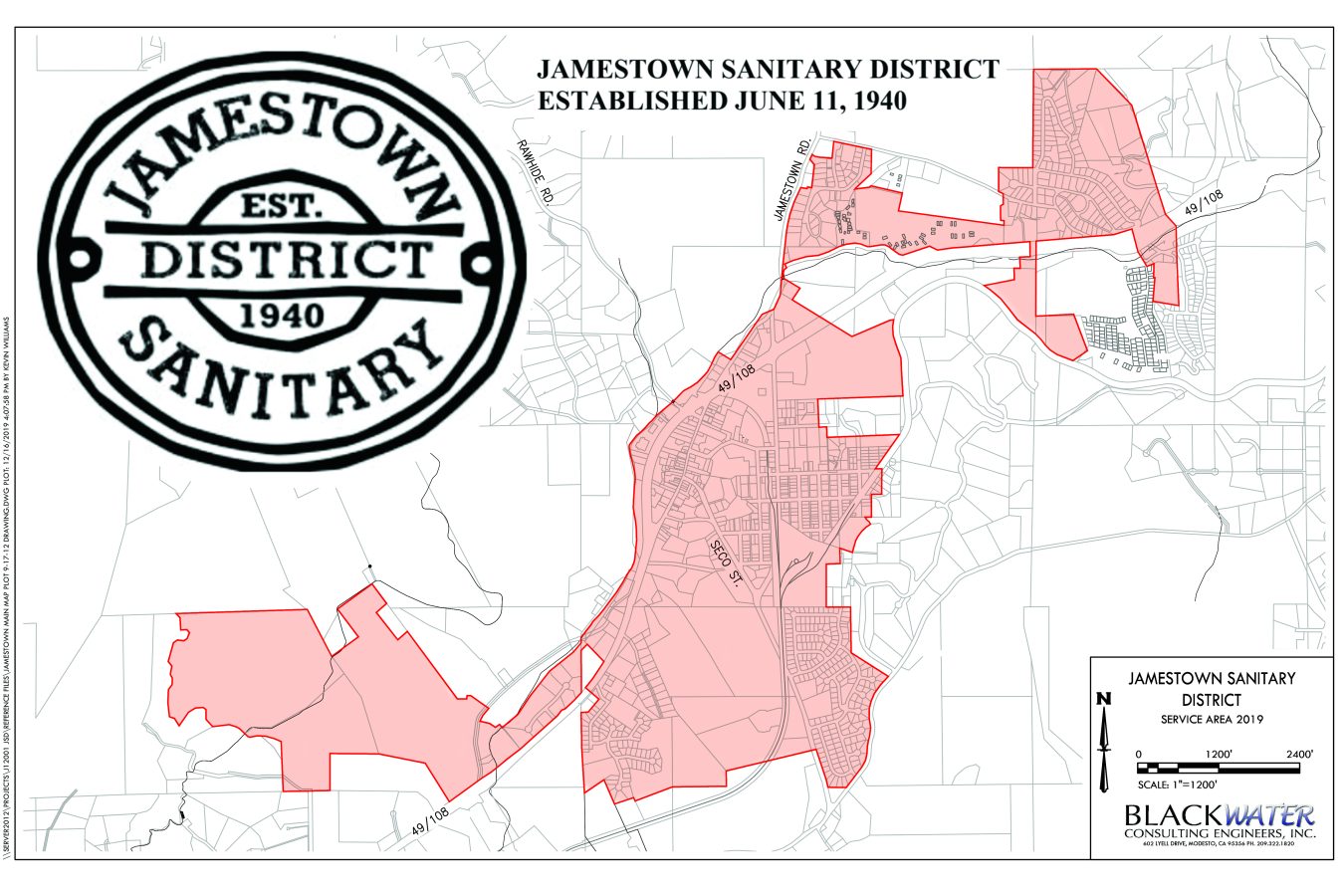
Jamestown, CA — The board of a small sanitary district facing looming financial challenges has implemented fees that are among the highest in the state as it works to dig itself out of debt.
Part one of our series about recent processes enacted by the Jamestown Sanitary District noted both a recently lifted moratorium on new capacity/connection fees and an increase for them that rose from a relatively low rung of $6,858 to $22,845, making them among California’s most expensive to obtain. The new cost has developers and other new users helping fund the building of essential capacity.
JSD’s current five-year sewer fee rate plan, now in year two, also incorporates a 65% rate hike. The fixed step-up schedule for the next three years calls for the annual fee to increase to $1,749.36 in July 2027, $1,924.32 in July 2028, and $2,313.12 in July 2029; the latter includes a new debt fee of $24.38. According to the district, the approved rates, part of its overall restructuring plan will fund system operations, satisfy state infrastructure regulations and prevent operational deficits.
Board President Duke York and Administration Supervisor/District Secretary Jill McClintock spoke with Central Sierra Broadcasting about the recent fee increases, the collections arrangement and addressed questions concerning the district’s challenges.
McClintock explained how, moving forward, every year in July beginning this summer, customers will receive an annual statement from JSD listing the total annual residential sewer charge. Currently, the annual fee is $1,590.36 per equivalent single-family residence (ESFR).
JSD ratepayers who do not pay a mortgage must figure it into their overall tax bill and payment schedule. While the overall tax bill will increase to cover the sanitary district fees, there is no additional charge for it to be handled through the county. Taxpayers cannot separate the charge from it or choose not to pay the total due, and failure to pay the total due will result in a property lien. Those with mortgages should anticipate that the monthly fee will be added by their lender to their monthly escrow payment figure.
The district approved the move back in June from handling its own monthly billing to formally implementing a payment process whereby ratepayer fees would henceforth be collected through the Tuolumne County Treasurer-Tax Collector’s Office.
New payment process
McClintock, who in June was preparing the data set of the district’s customer base to send to the county tax collector’s office, confided that not only was processing monthly paper bills, envelopes and postage for every household enormously expensive for the district, some customers were regularly opting not to pay their monthly fees.
Unlike power and water, she also pointed out that direct sanitary district service shutoffs for nonpayment are legally complex and time-consuming due to public health risks, environmental contamination and strict consumer protection laws.
She explained that ensuring payment by placing the fee on property tax bills will reduce overhead costs, help stabilize the district’s operational budget by eliminating unpaid accounts and allow its skeleton staff to spend more time managing the 2026 pipeline rehabilitation project and existing grant agreements, along with pursuing new grant opportunities.
In addition to McClintock, who is responsible for managing the district’s financial and administrative affairs, JSD staff include an Operations Supervisor/Chief Plant Operator, Nick Rivera, responsible for the operations of the wastewater treatment facility and collections system, along with a small team of state-licensed wastewater-certified operators. McClintock has been with the district since 2023, and Rivera, previously a JSD operator, was promoted to his current position in mid-2023.
JSD’s new collections being administered by the county are under a Teeter Plan, a system authorized by California law and used since 1949 by other utility districts to collect certain assessments, fees and standby/availability charges. The Teeter method is utilized by 90% of California counties for property taxes and other revenues collected via the property tax roll to ensure predictable, stable and timely revenue streams.
McClintock stressed that beyond the recent rate increase enacted under year two of the district’s five-year plan, despite any inaccurate rumors circulating through the community, customers will not assume any additional charges under the new collections system. However, as the district’s independent payment methods have shut down, outstanding account balances after June 30 are considered delinquent, and unless property owners with delinquent balances pay what they owe to the county, their balance due will be converted into property liens. Moving forward, failure to clear consolidated tax charges is subject to county penalties or property tax foreclosure charges.
Coming up in part three of our three-part series, district officials’ discussion of JSD’s debt and plans moving forward. Look for it on Friday.